
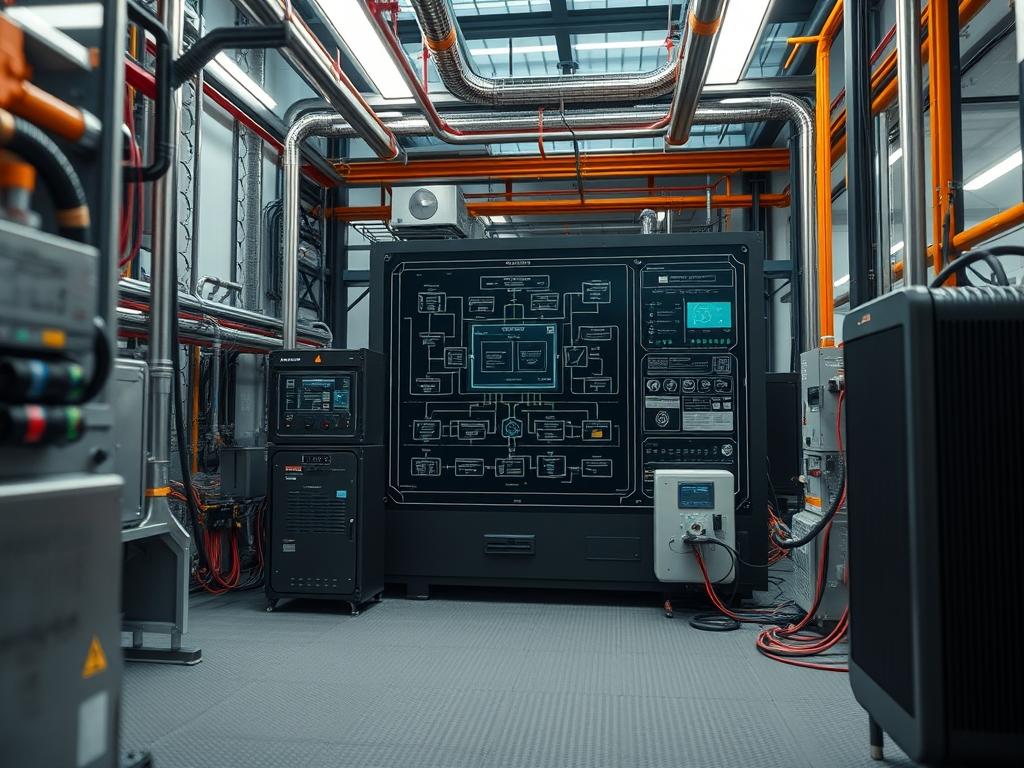
Standalone power systems represent the pinnacle of infrastructure autonomy; moving from grid-tied reliance to a decentralized energy model requires a rigorous Off Grid Inverter Setup. This process involves the transformation of variable Direct Current (DC) from photovoltaic arrays or battery banks into a stabilized Alternating Current (AC) waveform. Within the broader technical stack, the inverter serves as the gateway between raw energy storage and sensitive hardware loads; whether those loads are located in a remote telecommunications hub, a standalone research facility, or a localized cloud edge node. The architect must treat the inverter not merely as a power converter, but as the central logic controller of the entire site. It manages energy payloads, mitigates thermal-inertia risks, and ensures electrical throughput remains consistent under fluctuating harmonic demands. A failed configuration protocol leads to signal-attenuation in sensor circuits, reduced battery lifecycle via improper depth-of-discharge, and catastrophic hardware failure during peak surge events. This manual provides the architectural blueprints for a robust, industrial-grade implementation.
TECHNICAL SPECIFICATIONS
| Requirement | Operating Range | Protocol/Standard | Impact Level | Recommended Resource |
| :— | :— | :— | :— | :— |
| DC Input Voltage | 42.0 – 64.0 VDC | NEC 690.7 | 10 | 4/0 AWG Copper Cabling |
| AC Output Freq | 50/60 Hz +/- 0.1 | IEEE 1547 | 9 | Pure Sine Wave Logic |
| Communication | 9600 – 115200 bps | Modbus RTU / CAN | 7 | Shielded STP Cat6 |
| Surge Capacity | 200% for 5 Seconds | UL 1741 | 8 | High-Magnetic Breakers |
| Operating Temp | -20C to 50C | Thermal-Inertia | 6 | Active Fan / Heat Sink |
THE CONFIGURATION PROTOCOL
Environment Prerequisites:
Before initiating the Off Grid Inverter Setup, the lead engineer must verify compliance with local electrical codes such as NEC 2023 or local equivalent standards. The system environment requires a clean, dry, and ventilated space to prevent moisture-induced conductivity on the logic boards. Ensure the battery bank is balanced and the BMS (Battery Management System) is communicating. Necessary tools include a Fluke-179 Multimeter, a 1000V Insulated Torque Wrench, and a laptop with the manufacturer specific serial interface software installed. All users must have Administrative/Root permissions on the local configuration terminal to modify kernel-level protection setpoints.
Section A: Implementation Logic:
The engineering design of a standalone system relies on the principle of energy encapsulation. Unlike grid-tied systems that use the utility as a buffer, the off-grid system must account for every watt of overhead. The implementation logic follows a DC-coupled or AC-coupled topology. In a DC-coupled scenario, the inverter relies on a charge controller to manage the PV payload before it hits the battery bank. The “Why” behind this setup is efficiency: minimizing the number of inversion stages reduces conversion losses and heat dissipation. The inverter acts as an idempotent state machine; given a specific input voltage and load demand, it must produce a consistent, regulated output regardless of how many times the load cycles. Latency in the switching circuit must be minimized to under 20 milliseconds to prevent rebooting sub-systems like servers or PLCs during a transition from solar to battery power.
Step-By-Step Execution
1. DC Bus Initialization
Mount the inverter to a non-combustible surface and connect the Positive (+) and Negative (-) leads from the battery bank to the DC Input Terminals. Use an Amperage-Rated Disconnect Switch between the two.
System Note: This action initializes the internal capacitors. The architect should use a pre-charge resistor to prevent a massive current inrush that can damage the internal DC-link bus. This step synchronizes the inverter’s internal clock with the battery’s potential energy state.
2. Physical Grounding and Bonding
Connect the Equipment Grounding Conductor (EGC) to the Chassis Ground Lug and then to the site’s central Grounding Electrode System.
System Note: This creates a low-impedance path to earth. By establishing this bond, the system mitigates Electrical Fast Transients (EFT) and protects the internal logic gates from static discharge and signal-attenuation caused by common-mode noise.
3. Communication Bus Integration
Plug the RJ45 or RS485 cable into the Comms Port of the inverter and the other end into the System Gateway or Data Logger. Use the command cat /dev/ttyUSB0 on your terminal to verify the serial link is active.
System Note: This step allows for the telemetry of the system. It enables the inverter to report real-time data such as throughput, battery state-of-charge, and thermal-inertia variables to the monitoring dashboard. Failure here results in an “Information Vacuum” that prevents automated fail-safes.
4. Parameterization and Setpoint Tuning
Access the inverter software (e.g., VEConfigure or Sunny Explorer). Navigate to the Battery Settings and input the Absorption, Float, and Equalization voltages as defined by the battery manufacturer.
System Note: This writes specific variables to the inverter’s non-volatile memory. This is an idempotent operation where the logic ensures that even after a full power cycle, the inverter returns to these safety-critical setpoints to prevent over-discharging the cells.
5. AC Load Calibration
Wire the AC Output terminals to the Critical Loads Panel. Use a Fluke-376 FC Clamp Meter to measure the starting current of the largest expected load.
System Note: This final physical check ensures the inverter can handle the concurrency of multiple loads. It verifies that the inrush current does not exceed the inverter’s MOSFET peak ratings, which would trigger a hard shutdown of the AC output service.
Section B: Dependency Fault-Lines:
The primary bottleneck in any Off Grid Inverter Setup is the mismatch between peak load demand and the inverter’s thermal-inertia. If a system is sized too close to its maximum rating, the heat buildup within the transformers creates a bottleneck, leading to a de-rating of the output capacity. Another common fault-line is the presence of ground loops; when multiple grounding points exist at different potentials, it creates circulating currents that interfere with the Modbus communication packets, leading to intermittent packet-loss in the monitoring data. Finally, legacy firmware versions can cause conflicts with modern Lithium-Ion BMS protocols, resulting in a failure to charge despite available PV harvest.
THE TROUBLESHOOTING MATRIX
Section C: Logs & Debugging:
When a fault occurs, the first step is to analyze the internal event log. This is typically located at /var/log/power_system.log in integrated Linux-based controllers or via the LCD panel on the inverter face.
- Error String “Low Battery Cutout (LBCO)”: Check the DC Bus Voltage at the inverter terminals. If the voltage is higher at the battery than the inverter, check for high resistance in the 4/0 AWG Cable or loose terminal connections.
- Error String “Overload / Surge Fallback”: This indicates the load concurrency has exceeded the inverter’s rated throughput. Use a logic-analyzer to identify which appliance is causing the spike.
- Fault Code “F08: Bus Impedance”: This often points to a failed internal capacitor or a severe grounding issue. Verify the ground-to-neutral bond in the AC Output Panel.
- Visual Cues: A flashing red LED usually indicates a non-critical warning (e.g., high temperature); a solid red LED indicates a critical system halt. Use the manufacturer’s diagnostic tool to pull the specific hexadecimal error code to map it to the service manual.
OPTIMIZATION & HARDENING
Performance Tuning:
To maximize efficiency, the architect should adjust the Switching Frequency of the inverter. Higher frequencies result in a cleaner sine wave but increase the thermal-inertia and switching losses. Lowering the frequency (if supported) can increase throughput at the cost of slight harmonic distortion. Additionally, optimize the Search Mode settings; this allows the inverter to go into a low-power “hibernation” state when no AC load is detected, drastically reducing the idle overhead energy consumption.
Security Hardening:
In an era of connected infrastructure, the Off Grid Inverter Setup must be shielded from external interference. If the inverter uses a Wi-Fi or Ethernet module, it must be behind a dedicated firewall with strict iptables rules. Restrict access to Port 502 (Modbus TCP) to only authorized internal IP addresses. Physically, the inverter should be housed in a lockable NEMA 4X enclosure to prevent unauthorized tampering with the DC Disconnect or the Reset Switch. Ensure all firmware checksums are verified before any update to prevent the injection of malicious payloads into the power control kernel.
Scaling Logic:
When the site’s energy demand grows, the setup must be scaled via parallel stacking. This involves connecting multiple identical inverters to the same DC and AC bus. The architect must designate one unit as the “Leader” and the others as “Followers” via the communication cabling. This configuration allows for increased throughput and redundancy; if one unit fails, the others can carry a portion of the load (concurrency management). Ensure that the cable lengths between the batteries and each inverter are identical to the millimeter to prevent impedance mismatch and uneven current draw.
THE ADMIN DESK
How do I fix a communication timeout error?
Check the termination resistors on the RS485 bus. Ensure a 120-ohm resistor is present at both ends of the chain. Verify that no two devices share the same Modbus ID to prevent address collisions.
Why is my inverter de-rating in the afternoon?
This is a response to thermal-inertia. Ensure the cooling fans are free of dust and that there is at least 12 inches of clearance around the intake vents. Consider adding external active cooling if ambient temperatures exceed 40C.
Can I mix different battery brands in one setup?
Strictly forbidden. Different chemistries have different internal resistances and charging curves. Mixing them will lead to unbalanced payloads and can trigger a DC Overvoltage or Thermal Runaway event in the weaker bank.
What is the minimum battery voltage for startup?
Most 48V inverters require a minimum of 44 VDC to engage the internal logic. If the bank is below this, use an external charger to bootstrap the system until the inverter’s internal charging logic can take over.
Is it necessary to use shielded cable for the sensors?
Yes. High-voltage DC cables generate significant electromagnetic interference (EMI). Unshielded sensor wires will experience signal-attenuation and noise, leading to inaccurate SOC readings and potential system instability.