
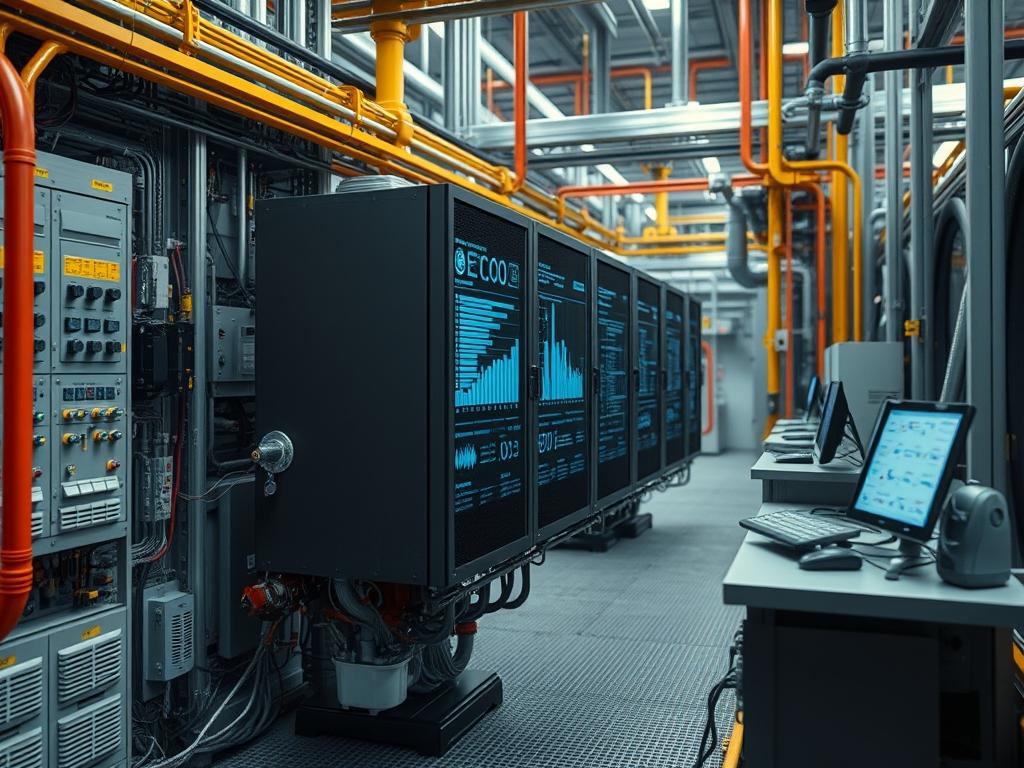
Inverter thermal management is a critical constraint in power electronics infrastructure, specifically regarding the thermal limits of Insulated-Gate Bipolar Transistors (IGBTs) and Metallic-Oxide-Semiconductor Field-Effect Transistors (MOSFETs). The Inverter Operating Temperature directly dictates the maximum permissible throughput of the power conversion stage. When the internal junction temperature ($T_j$) approaches the design threshold of the semiconductor substrate, the control logic initiates a derating sequence. This process reduces the Pulse Width Modulation (PWM) duty cycle or switching frequency to decrease conduction and switching losses.
Within utility-scale energy storage, industrial motor drives, and telecommunications power plants, the inverter serves as the primary bridge between Direct Current (DC) sources and Alternating Current (AC) loads. Thermal inertia in the heat sink assembly determines the latency between load spikes and derating triggers. If the Inverter Operating Temperature exceeds the maximum operational envelope, the system enters a hard-fault state to prevent catastrophic hardware failure, resulting in immediate downtime and potential packet loss in networked control systems. Effective management requires precise synchronization between physical cooling assets, firmware-level thermal modeling, and external supervisory control and data acquisition (SCADA) systems.
| Parameter | Value |
| :— | :— |
| Nominal Operating Range | -25C to +45C ambient |
| Critical Derating Threshold | +50C (Internal Ambient) |
| Maximum Junction Temperature | +150C (IGBT Typical) |
| Communication Protocols | Modbus TCP/RTU, SNMP v3, CANopen |
| Default Management Port | 502 (Modbus), 161 (SNMP) |
| Monitoring Interval | 100ms to 1000ms |
| Thermal Sensor Type | PT100/PT1000 RTD or NTC Thermistor |
| Cooling Control Logic | PID or Hysteresis-based PWM |
| Environmental Tolerance | IP65 (Outdoor) / IP20 (Indoor) |
| Security Exposure | High (Unencrypted Industrial Protocols) |
| Recommended Hardware | ARM Cortex-M4 or FPGA-based Controller |
| Throughput Reduction Rate | 2.5 percent per degree C above threshold |
Configuration Protocol
Environment Prerequisites
Deployment of thermal management logic requires the inverter firmware to be at minimum version 4.2.0 to support dynamic frequency scaling. The physical environment must maintain a minimum volumetric airflow of 500 Cubic Feet per Minute (CFM) for rack-mounted units. All thermal sensors must be calibrated against a NIST-traceable reference such as a Fluke 724 temperature calibrator to ensure the reported Inverter Operating Temperature matches the actual physical state. The management network must be isolated on an out-of-band VLAN with firewall rules restricting access to the Modbus gateway.
Implementation Logic
The engineering rationale for performance derating relies on the conservation of semiconductor lifespan. For every 10C increase in Inverter Operating Temperature, the Mean Time Between Failure (MTBF) of the capacitor bank and switching components is reduced by approximately 50 percent. The controller utilizes a state-space thermal model to predict junction temperatures based on current flow ($I_{out}$) and measured heat sink temperature. When the model predicts $T_j$ will exceed 125C, the firmware enters a kernel-space interrupt routine that modifies the PWM generator’s current limit. This encapsulates the protection logic at the lowest level of the execution stack to ensure fail-safe operation regardless of user-space load or network congestion.
Step By Step Execution
Validate Sensor Integration via Modbus
Verify that the internal thermistors are reporting accurate data to the control registers. Use mbpoll or a similar utility to poll the temperature registers.
“`bash
mbpoll -m tcp -a 1 -r 40021 -c 3 -t 4:int 192.168.10.50
“`
Internal logic: This command queries the holding registers starting at 40021. Register 40021 typically stores the Inverter Operating Temperature in Celsius with a scale factor of 10. The controller processes the raw ADC (Analog-to-Digital Converter) value and writes the result to the Modbus map every 500ms.
System Note: If the return value is 32767 or -32768, the sensor circuit is open or shorted. Inspect the PT1000 lead wires for mechanical stress.
Adjust Derating Curve Thresholds
Modify the firmware configuration file to set the start and end points of the thermal derating slope. Access the configuration via the CLI or by uploading a config.xml file.
“`yaml
thermal_management:
derate_start_temp: 50.0
derate_end_temp: 75.0
max_output_percentage: 100
min_output_percentage: 20
hysteresis_offset: 2.0
“`
Internal logic: The controller applies a linear slope between 50C and 75C. If the Inverter Operating Temperature is 62.5C, the output power is capped at 60 percent. The hysteresis_offset prevents the system from oscillating rapidly between power levels when the temperature fluctuates around the 50C threshold.
System Note: Always maintain a minimum min_output_percentage to ensure critical house loads or synchronization signals remain active.
Configure Active Cooling Response
Link the Inverter Operating Temperature to the external cooling fan controller. This is often handled via a 0-10V analog output or a PWM signal from the GPIO header.
“`bash
Set GPIO 18 to PWM mode for fan control
gpio -g mode 18 pwm
Write PWM value based on temp (Range 0-1024)
gpio -g pwm 18 512
“`
Internal logic: Increasing the cooling fan speed reduces the thermal resistance between the heat sink and the ambient air. By ramping fan speed early (e.g., at 40C), the system can delay the onset of derating, maintaining higher throughput for longer durations.
System Note: Utilize a PID (Proportional-Integral-Derivative) loop in the PLC logic to prevent fan motor wear caused by rapid cycling.
Dependency Fault Lines
Thermal bottlenecks are often the result of secondary system failures rather than primary inverter malfunctions. Common fault lines include:
1. Air Filter Clogging: In high-dust environments, the airflow throughput drops, increasing the Inverter Operating Temperature even at low loads.
– Root Cause: Particulate accumulation on the intake mesh.
– Verification: Measure the pressure differential across the intake using a manometer.
– Remediation: Implement a preventative maintenance schedule for filter replacement.
2. Terminal Torque Decay: Loose electrical connections at the DC bus or AC output create high-resistance junctions.
– Root Cause: Thermal cycling causing physical expansion and contraction, loosening bolts.
– Verification: Perform a thermographic scan using an infrared camera to locate hotspots.
– Remediation: Retighten all terminals to the manufacturer-specified torque values (e.g., 12 Nm).
3. Controller Desynchronization: If the monitoring daemon loses contact with the thermal sensors, it may default to a maximum derating state for safety.
– Root Cause: EMI (Electromagnetic Interference) on the sensor bus.
– Verification: Check journalctl -u inverter-monitor for “Sensor Timeout” errors.
– Remediation: Install shielded twisted-pair (STP) cabling for all sensor runs and ensure proper grounding.
Troubleshooting Matrix
| Symptom | Fault Code | Log Source | Verification Step |
| :— | :— | :— | :— |
| Rapid Power Drop | E-104 (Derating) | syslog | Check register 40021 for values > 50.0 |
| Hard Shutdown | E-105 (OverTemp) | dmesg | Inspect IGBT heat sink for physical obstruction |
| Fan Failure Alarm | E-201 (FanFault) | snmptrap | Check PWM feedback signal on GPIO pin 22 |
| Inconsistent Data | CRC Error | modbus.log | Verify RS-485 termination resistor (120 Ohm) |
| High Ambient Alert | W-005 (Warning) | dashboard | Compare internal vs. external ambient sensors |
Diagnostic Workflow
If the system reports excessive Inverter Operating Temperature while idling, perform the following:
1. Stop the inverterd service: systemctl stop inverterd.
2. Query the raw thermistor resistance using a multimeter at the controller interface.
3. Check the netstat -an | grep 502 output to ensure no unauthorized instances are polling the registers and causing CPU overhead on the controller.
4. Execute journalctl -f and watch for “Thermal Trip” events while gradually increasing the load.
Optimization And Hardening
Performance Optimization
To maximize throughput, the switching frequency should be dynamically adjusted. Lowering the frequency from 16kHz to 8kHz significantly reduces switching losses, which lowers the Inverter Operating Temperature. This allows the unit to carry a higher current load before reaching the derating threshold, though it may increase total harmonic distortion (THD).
Security Hardening
Inverters are increasingly targets for industrial espionage and sabotage. All management traffic must be encapsulated within a VPN or SSH tunnel.
– Disable unused services: systemctl disable telnet rsh.
– Apply iptables rules to allow only the SCADA IP address to access Port 502.
– Use SNMP v3 with AES encryption and SHA authentication for all remote telemetry to prevent Man-In-The-Middle (MITM) attacks that could forge thermal data.
Scaling Strategy
For high-availability clusters, implement an N+1 redundancy model. Configure the load balancer to shift the payload from the warmest inverter to the coolest unit in the array. This “thermal leveling” approach ensures that no single device reaches the derating threshold prematurely. Capacity planning should assume a 20 percent derating buffer for peak summer ambient temperatures.
Admin Desk
How do I identify if derating is active via CLI?
Poll the operational status register. For SunSpec-compliant devices, check the St (Status) and TmpCab (Cabinet Temperature) registers. A status code of ‘3’ typically indicates throttled operation due to thermal constraints. Use mbpoll to verify real-time status.
What is the fastest way to lower Inverter Operating Temperature?
Immediately reduce the AC current limit via the control interface. If accessibility is limited, increasing the external ventilation or activating emergency bypass cooling systems will dissipate heat sink energy. Reducing the switching frequency is the most effective firmware-level change.
Can I bypass the thermal derating limit for emergencies?
This is not recommended as it risks IGBT rupture or fire. If necessary, some controllers allow temporary adjustment of the critical_trip_point via an engineering-level password. This voids the manufacturer warranty and substantially increases the risk of unit failure.
Why does the inverter derate even when the room is cold?
Check for internal airflow obstructions or failed internal circulation fans. If the heat sink fins are clogged with debris, the Inverter Operating Temperature will rise rapidly regardless of ambient conditions. Verify that the thermal paste between the IGBT and heat sink has not dried.
How often should I calibrate the thermal sensors?
Sensors should be verified annually. Use a calibrated heat source and compare the reading in the inverter software to the reference thermometer. Significant drifting (more than 2C) indicates a failing thermistor or a degrading analog input channel on the controller cabinet.