
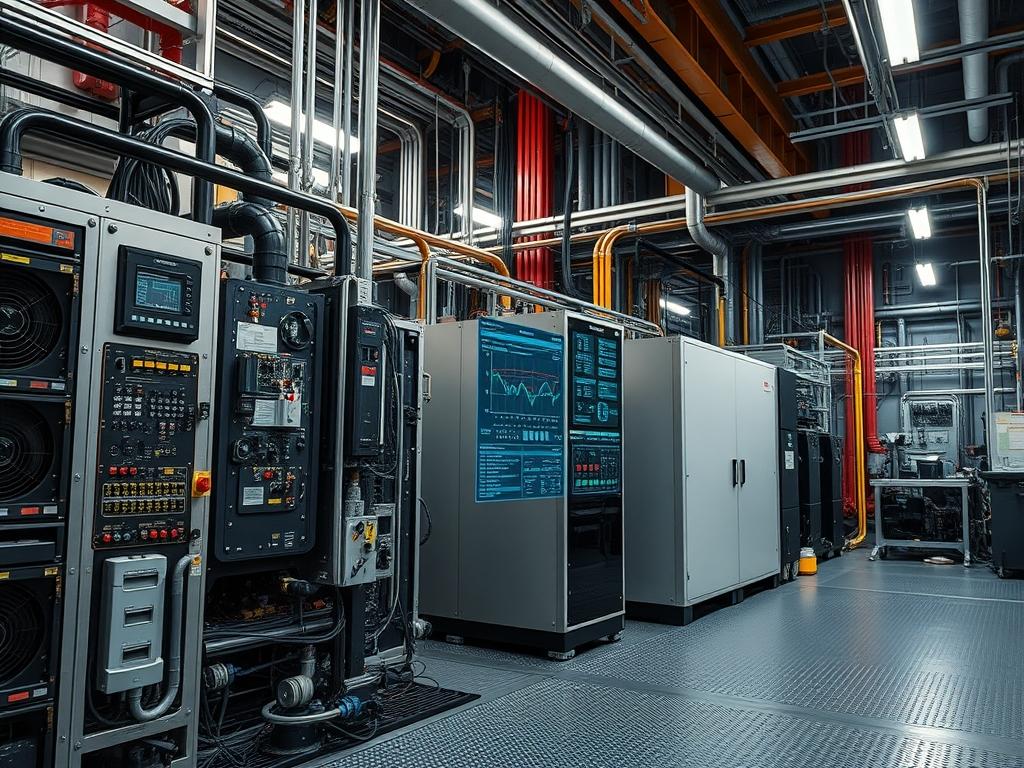
Inverter Time of Use (TOU) represents the logic layer governing energy arbitrage and grid demand response within an industrial or residential power plant. These systems serve as the primary edge nodes for managing the bidirectional flow of electricity between an Electrochemical Energy Storage System (EESS), local loads, and the utility grid. By programmatically shifting energy intake and discharge based on periodic tariff schedules, the Inverter Time of Use system decouples the immediacy of energy consumption from the volatility of grid pricing. Integration typically occurs through a layered architecture involving a base power conversion system (PCS), a local energy management system (EMS) controller, and an upstream utility interface. Failure in this layer results in significant financial penalties, increased grid reliance during peak demand, or potential violation of utility interconnection agreements. Operational dependencies include sub-millisecond clock synchronization, high-fidelity metering data, and steady-state thermal management of the power electronics modules. The system must maintain low-latency communication via industrial buses to ensure that power setpoints are adjusted before tariff transitions occur.
| Parameter | Value |
| :— | :— |
| Communication Protocol | Modbus TCP, Modbus RTU, SunSpec IEEE 1547 |
| Default TCP Port | 502 |
| Physical Layer | RS485 or 10/100 Mbps Ethernet |
| Operating Voltage Range | 200Vdc to 1000Vdc (System Dependent) |
| Nominal Frequency | 50Hz or 60Hz |
| Clock Accuracy Requirement | < 1.0 second drift per month; NTP Synchronized |
| Security Standard | IEC 62443-4-2 compliant |
| Target Latency | < 100ms for command execution |
| Environmental Tolerance | -20C to +60C with de-rating above 45C |
| High Availability | N+1 Controller Redundancy recommended |
Configuration Protocol
Environment Prerequisites
Implementation requires an inverter firmware version validated for external setpoint control, typically version 2.4.0 or higher for most industrial units. The controller, whether a dedicated Logic Controller or a Linux based gateway, must have a stable Network Time Protocol (NTP) source to prevent schedule drift. All RS485 wiring must utilize shielded twisted pair cables (STP) with 120-ohm termination resistors at both ends of the bus to mitigate signal attenuation. Access to the inverter service menu via a technician level password or an SSH key is mandatory for unlocking writable Modbus registers.
Implementation Logic
The engineering rationale for Inverter Time of Use programming centers on a state machine that transitions between Charging, Discharging, and Minimal Load states. The dependency chain relies on the interaction between the local battery management system (BMS) and the inverter power stage. The BMS dictates the maximum allowable charge and discharge currents based on current cell temperatures and state of charge (SOC). The TOU logic acts as an override layer that clamps these values based on the time of day. If the controller loses communication with the inverter, the system must default to a fail-safe mode where battery discharge is inhibited to prevent unintended depletion during low tariff hours.
Step By Step Execution
Establish Communication and Register Mapping
Access the inverter communication board using a Fluke multimeter to verify DC voltage on the RS485 A and B lines, then connect the controller to the Modbus port. Utilize a tool like mbpoll to query the inverter identification registers to ensure the bus is active.
“`bash
Verify connection to inverter at ID 1 over Modbus TCP
mbpoll -m tcp -a 1 -r 40001 -c 10 192.168.1.50
“`
This action confirms that the controller can reach the inverter internal register map. You must identify specific registers for Charge Power Limit (often a 16-bit unsigned integer) and Discharge Power Limit. These registers allow the TOU logic to throttle power flow.
System Note
Registry addresses vary between manufacturers. Always reference the specific SunSpec PICS (Protocol Implementation Conformance Statement) for your hardware model. Common holding registers are often located in the 40000+ range.
Configure NTP and System Time
Clock drift is the primary cause of TOU failure. Program the controller to synchronize with a local or stratum 1 NTP server every 3600 seconds. Use timedatectl to verify synchronization status.
“`bash
Check synchronization status
timedatectl status
Force manual sync if drift is detected
ntpdate -u pool.ntp.org
“`
Internal inverter clocks must match the external controller. Many inverters require a specific Modbus write command to update their internal Real Time Clock (RTC) from the master controller.
System Note
If the inverter time differs from the utility company time by more than 30 seconds, the system may discharge energy into a low tariff period, negating the savings.
Deploy Daemonized TOU Logic
Create a service file using systemd to run a Python based logic loop. This loop monitors the current time and writes the corresponding power limits to the inverter.
“`ini
[Unit]
Description=Inverter Time of Use Logic Controller
After=network.target
[Service]
ExecStart=/usr/bin/python3 /opt/tou/manager.py
Restart=always
RestartSec=5
[Install]
WantedBy=multi-user.target
“`
The manager.py script uses libraries like pymodbus to perform periodic writes. For example, at 14:00 (Peak), it sets the Discharge Limit to 100 percent and the Charge Limit to 0 percent.
System Note
The script must prioritize BMS alarms. If a thermal sensor reports battery temperatures exceeding 55C, the script must immediately write 0 to all power limit registers regardless of the TOU schedule.
Implement State Observation via MQTT
Redirect telemetry from the inverter to a centralized monitoring system using mosquitto_pub. This allows for real time auditing of the TOU performance and state transitions.
“`bash
Example command within the logic loop to report state
mosquitto_pub -h 192.168.1.10 -t “energy/inverter/state” -m “{\”mode\”: \”TOU_DISCHARGE\”, \”soc\”: 85, \”power\”: 5000}”
“`
This provides a data stream for external validation and long term performance analysis.
System Note
Use netstat -tuln on the controller to ensure port 502 and port 1883 are managed and not blocked by local iptables rules.
Dependency Fault Lines
Dependency mismatches between the inverter firmware and the EMS controller often result in write failures to holding registers. If the inverter expects a 32-bit float but the controller sends a 16-bit integer, the logic will trigger a Modbus Exception Code 03 (Illegal Data Value).
Signal attenuation on the RS485 bus due to improper shielding or ground loops causes intermittent packet loss. This is observable as cyclic timeouts in the controller logs. Remediation involves checking the termination resistance or switching to an optically isolated RS485 to USB converter.
Controller desynchronization occurs when the local RTC battery fails. In the event of a power outage, the controller may reboot with a default epoch time of 1970-01-01. Without an active network connection for NTP, the TOU logic will execute the wrong schedule. Verification involves checking journalctl -u tou-manager.service for time-jump warnings.
Thermal bottlenecks in the inverter power stage or battery racks will trigger internal derating. Even if the TOU logic requests a 10kW discharge, the hardware may cap output at 2kW. This is a physical constraint, not a logic error. Check the SNMP traps for “Over-temperature Derating” alerts.
Troubleshooting Matrix
| Symptom | Root Cause | Verification Method | Remediation |
| :— | :— | :— | :— |
| Schedule not triggering | NTP Sync Failure | Run timedatectl | Restore internet or local GPS clock source |
| Modbus Timeout Error | Physical Link Break | Use netstat to check port 502 | Check cable continuity; restart daemonized service |
| Unexpected Discharge | Wrong Register Address | Check syslog for Modbus errors | Update register map to match firmware version |
| Low Capacity Logic | SOC Drift | Compare BMS vs Inverter SOC | Run a full charge/discharge cycle for recalibration |
| High Latency Commands | Network Congestion | Run tcpdump on port 502 | Isolate inverter traffic to a dedicated VLAN |
Example journalctl output for a failed TOU transition:
`Feb 12 17:00:01 edge-gateway python3[1204]: ERROR: Modbus Error: [Invalid Message] No response received from slave 1`
`Feb 12 17:00:05 edge-gateway python3[1204]: WARNING: TOU Transition to PEAK failed. Retrying in 5s…`
Optimization And Hardening
Performance Optimization
To improve throughput, implement block-coordinated Modbus reads. Instead of requesting individual registers for voltage, current, and SOC, request a single 20-register block to reduce overhead on the inverter processor. Adjust the logic loop for a PID controller approach when approaching SOC limits to prevent abrupt power oscillations that stress the DC bus capacitors.
Security Hardening
Isolate the inverter and controller within a management VLAN. Disable all unnecessary services like Telnet or unencrypted HTTP on the inverter WebUI. Apply iptables rules to the controller to only allow traffic from the authorized management IP range.
“`bash
Allow Modbus only from the Management LAN
iptables -A INPUT -p tcp -s 10.0.50.0/24 –dport 502 -j ACCEPT
iptables -A INPUT -p tcp –dport 502 -j DROP
“`
Scaling Strategy
For sites with multiple inverters, utilize a horizontal scaling approach where a primary EMS controller orchestrates several secondary inverters. Implement a load balancing algorithm that distributes the discharge target across all inverters based on their relative battery health and current thermal state. This redundancy ensures that if one unit fails, the remaining units can compensate to meet the TOU savings target.
Admin Desk
How do I verify the inverter is following the TOU schedule?
Monitor the Modbus register for Active Power Setpoint. Cross-reference the timestamp with your programmed CSV or JSON schedule. Use journalctl -u inverter-logic to see real time state transitions and any rejected write commands from the inverter.
What causes the SOC to stay at 100% during peak hours?
This usually indicates a Charge Limit register is stuck or the inverter is in Forced Charge mode. Check for a local manual override on the inverter physical display or an active SNMP alarm indicating a grid-requested emergency charge.
The inverter time is correct but the logic triggers an hour late.
Verify the system timezone settings using timedatectl. Most industrial inverters operate on UTC. If your logic script uses local time but the inverter expects UTC, the transition will be offset by your GMT offset.
Can I change TOU parameters over a cellular connection?
Yes, provided the gateway uses a secure tunnel. Optimize MQTT payloads to reduce data consumption. Ensure the PID controller frequency is lowered (e.g., every 30 seconds instead of 1 second) to minimize cellular overhead and latency spikes.
Why does the battery stop discharging at 20% SOC?
Inverters have a hard-coded Depth of Discharge (DOD) limit to protect battery chemistry. Even if the TOU logic requests a discharge, the internal BMS will override and halt current flow once the minimum voltage threshold is reached.