
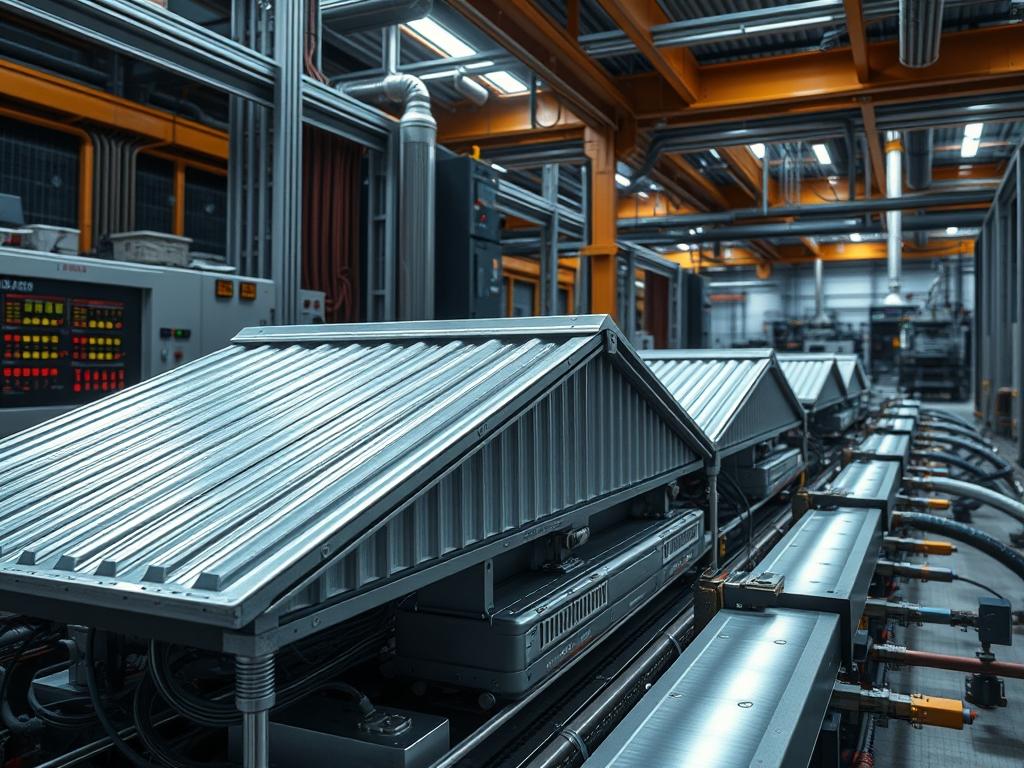
Deployment of Corrugated Metal Roof Brackets constitutes the critical mechanical interface layer in industrial facility management. These components function as the physical abstraction between the building envelope and auxiliary hardware such as solar rails, HVAC struts, or satellite mounts. In the context of critical infrastructure, these brackets provide the necessary structural anchorage while maintaining the integrity of the moisture barrier and thermal envelope. Failure in this layer propagates through the system as water ingress, which leads to structural degradation of the underlying purlins and potential electrical short circuits in high voltage equipment located beneath the roofline. The integration of these brackets must account for the mechanical properties of the roof deck, typically 24 gauge or 26 gauge steel, and the specific geometry of the corrugation profiles. Proper execution ensures that shear and uplift forces are distributed throughout the sub-structure rather than localized on the thin gauge paneling. This reduces the risk of fastener pullout during high wind events or seismic activity. Operational uptime depends on the longevity of the seals, which must withstand high UV exposure and extreme thermal cycling without losing elasticity or adhesion.
Technical Specifications
| Parameter | Value |
| :— | :— |
| Primary Material | 6000 series Aluminum or 304 Stainless Steel |
| Fastener Type | Self-drilling M6.3 or 1/4 inch with EPDM washers |
| Sealing Compound | Neutral cure silicone or Butyl tape |
| Operating Temperature | -45C to +90C |
| Tensile Strength (Uplift) | 2.5 kN to 8.0 kN depending on gauge |
| Shear Capacity | 1.8 kN to 5.5 kN |
| Standards Compliance | ASTM E1592, TAS 114, UL 2703 |
| Corrosion Resistance | 1000 hour Salt Spray (ASTM B117) |
| Torque Specification | 12 Nm to 18 Nm |
| Expected Service Life | 25 to 30 Years |
Configuration Protocol
#### Environment Prerequisites
Installation requires a comprehensive audit of the existing roof surface and sub-structure. The following dependencies must be satisfied before deployment. The roof panel gauge must be verified using a micrometer to ensure it meets the minimum thickness specified by the bracket manufacturer. Structural purlins must be mapped to ensure fasteners penetrate the primary steel frame where heavy loads are expected. All surfaces must be decontaminated using isopropyl alcohol or a similar solvent to allow the EPDM seals to form an airtight bond. Personnel must possess safety certifications for working at heights and must use calibrated torque drivers to prevent over-compression. Compliance with local building codes and ASCE 7 wind load requirements is mandatory for all industrial installations.
#### Implementation Logic
The engineering rationale for using specific Corrugated Metal Roof Brackets hinges on the concept of load dispersion. Unlike flat roof systems that rely on ballast, corrugated systems require mechanical attachment. The architecture utilizes the peak of the corrugation rib for fastening. This logic avoids the valley where water flow is concentrated, reducing the hydrostatic pressure on the seals. The dependency chain flows from the purlin to the panel, then to the bracket, and finally to the mounted equipment. Each connection point represents a failure domain. By using EPDM gaskets as an interface, we create a thermal break that prevents galvanic corrosion between dissimilar metals, such as an aluminum bracket mounted to a Galvalume steel roof. The assembly uses an idempotent strategy for fastening: once the torque limiter on the driver disengages at the set threshold, the seal is pressurized to the optimal level for fluid rejection without deforming the metal substrate.
Step By Step Execution
Substrate Analysis and Layout Mapping
Before physical penetration, the technician must identify the coordination between the roof ribs and the underlying structural members. Use a high powered magnet or an ultrasonic thickness gauge to locate the purlins. Mark the bracket locations along the high ribs at intervals determined by the engineering load calc.
System Note: Log the layout coordinates into a building information modeling (BIM) system or a simple JSON schema for future maintenance tracking. This data can be ingested by facility management software to monitor the health of specific roof sectors via SNMP linked environmental sensors.
Sealant Application and Bracket Positioning
Apply a layer of Butyl tape or a bead of high grade silicone to the underside of the bracket base. Ensure the sealant surrounds each pre-drilled fastener hole. Position the bracket onto the corrugation peak, aligning it with the structural marks made during layout mapping.
System Note: If the environment is subject to high chemical exposure, such as near exhaust stacks, use a specialized chemically resistant sealant to prevent degradation. Monitor the ambient temperature using a Fluke IR thermometer: do not apply sealants if the roof temperature exceeds the manufacturer limits for adhesion.
Fastener Integration and Torque Control
Drive the self-drilling fasteners through the bracket and into the roof rib. It is critical to use a driver with a clutch set to the specific Nm rating required by the bracket specification. The fastener must penetrate the purlin by at least 3 threads for maximum pullout resistance.
System Note: Check the fastener heads for proper seating. An over-driven screw will crush the EPDM washer, while an under-driven screw will leave a gap for moisture. Use the journalctl command on a connected digital torque wrench if your team utilizes IoT-connected tools to log every fastener installation event for quality assurance.
Electrical Bonding and Continuity Testing
For solar or telecommunications mounts, the bracket must be bonded to the facility grounding system. Use a stainless steel grounding clip or a copper lug to connect the bracket to the 6 AWG grounding conductor.
System Note: Verify the resistance using a Fluke multimeter set to the ohms range. Resistance should be less than 0.1 ohms between the bracket and the main ground busbar. This prevents static buildup and provides a path for surge currents, protecting the internal network infrastructure from lightning strikes.
Post-Installation Stress Test
Perform a manual pull test on 5 percent of the installed brackets to ensure no fastener stripping occurred. Inspect the perimeter of each bracket for sealant squeeze-out, which indicates a complete moisture seal.
System Note: Use a thermal imaging camera to inspect the roof from the underside during the next rain event or after a localized spray test. Any thermal anomalies or moisture detection should trigger an immediate remediation ticket in your ITSM platform, such as ServiceNow or Jira.
Dependency Fault Lines
Several operational failures typically occur during the bracket deployment lifecycle.
Galvanic Corrosion
Root Cause: Direct contact between aluminum brackets and zinc-coated steel without a protective gasket.
Symptoms: Powdery white residue around the bracket base and eventual perforation of the roof panel.
Verification: Visual inspection and testing for electrical continuity where isolation was intended.
Remediation: Re-install brackets with fresh EPDM isolation layers and replace damaged roof panels.
Fastener Stripping
Root Cause: Over-torquing during installation or using fasteners designed for a different gauge of steel.
Symptoms: The bracket feels loose or spins around the fastener axis.
Verification: Manual tension test.
Remediation: Use an oversized “repair” fastener or relocate the bracket 50mm away and patch the original hole.
Thermal Expansion Fatigue
Root Cause: Long runs of mounted hardware (like solar rails) without thermal expansion joints.
Symptoms: Elongated fastener holes or sheared screw heads.
Verification: Inspect for linear movement marks on the roof surface.
Remediation: Install expansion couplings every 6 to 10 meters to decouple the thermal inertia of the rails from the brackets.
Troubleshooting Matrix
| Symptom | Detected By | Potential Root Cause | Diagnostic Action |
| :— | :— | :— | :— |
| Moisture ingress | Ceiling stains / Humidistat | Sealant failure or over-torque | Inspect with thermal camera |
| Vibration noise | Acoustic sensors | Loose bracket or wind lift | Tighten to spec Nm |
| Signal Loss | Network monitor | Grounding fault or EMI | Check continuity with multimeter |
| Surface rust | Visual | Scratched protective coating | Apply cold galvanizing spray |
| Dislodged bracket | Visual / Drone | Fastener pullout (wind load) | Verify purlin engagement |
Optimization And Hardening
#### Performance Optimization
To maximize the throughput of the load handling system, implement a staggered bracket pattern. This avoids concentrated stress on a single purlin and utilizes the entire roof diaphragm for stability. Reducing the distance between brackets (increasing density) decreases the per-unit load, extending the fatigue life of the metal ribs. Every 10th bracket should be checked for torque retention after the first 90 days of service.
#### Security Hardening
Prevent unauthorized removal of hardware by using security fasteners such as Torx with a center pin. This provides an additional layer of protection for rooftop telecommunications equipment. For high-security environments, apply a tamper-evident paint or “torque seal” across the fastener head and the bracket body. If the seal is broken, it indicates an unauthorized manual intervention or structural shift.
#### Scaling Strategy
When scaling from a pilot installation (e.g., 50 brackets) to a full-scale deployment (5,000 brackets), prioritize the use of automated torque logging tools. Centralizing this data via a custom Python script that parses CSV logs from smart drivers ensures 100 percent compliance. Implement a high availability mounting design where each rail is supported by at least three brackets, ensuring a single bracket failure does not result in a catastrophic drop of the payload.
Admin Desk
How do I handle mismatched rib profiles?
Custom adapter plates must be CNC machined to match the exact pitch and height of the corrugation. Never attempt to flatten a rib or bend a bracket foot to fit, as this compromises the structural load path and voids the warranty.
What is the minimum purlin thickness for safe mounting?
Standard industrial brackets require at least 16 gauge (1.5mm) steel purlins for structural anchorage. If the purlins are thinner, use a toggle-bolt style fastener that grips the underside of the panel, though this significantly reduces maximum uplift capacity.
Can I install these brackets during rain or high humidity?
No. Moisture prevents Butyl and silicone from bonding to the metal substrate. Surface moisture trapped under the seal will lead to localized oxidation. Wait for a dry window and verify the surface is dry using a moisture meter.
Are these brackets compatible with standing seam roofs?
No. Corrugated Metal Roof Brackets require penetration into the rib or purlin. Standing seam roofs require non-penetrating clamps that grip the vertical seam. Using a corrugated bracket on a standing seam roof will destroy the system’s thermal movement capability.
How often should the EPDM seals be inspected?
Inspect every 24 months in standard environments or every 12 months in areas with high UV index or salt spray. Check for cracking, hardening, or shrinking. If the EPDM is brittle, the bracket system should be scheduled for a seal replacement.