
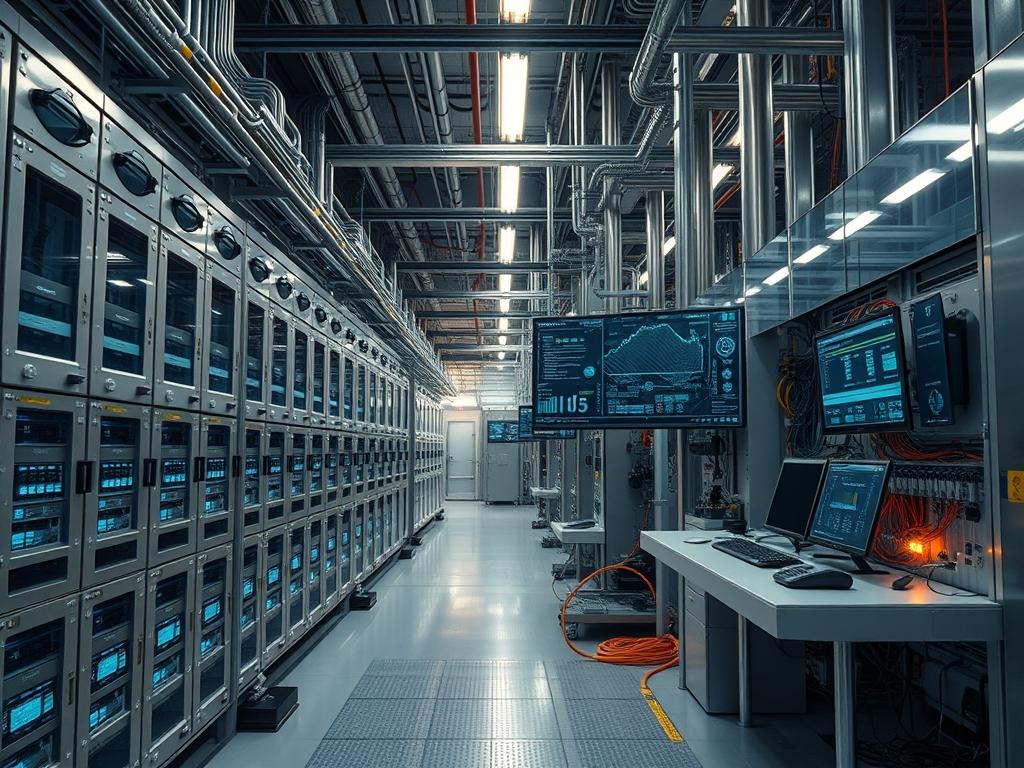
Rafter Centering Techniques within a high density datacenter environment or industrial facility represent the foundational structural alignment protocol required for overhead infrastructure deployment. Precision centering ensures that secondary support systems, such as fiber raceways, busway power distribution, and seismic bracing, maintain a direct load path to the primary structural members. Failure to adhere to exacting centering standards introduces eccentric loading into the overhead grid, potentially exceeding the lateral shear thresholds of the mounting hardware. This protocol utilizes a combination of laser telemetry and mechanical indexing to eliminate cumulative error across long spans. By standardizing the centering process, engineers can ensure that the physical layer infrastructure aligns perfectly with the logical rack rows below, preventing obstruction of airflow and maintaining compliance with thermal management designs. This systematic approach is critical for supporting the excessive weight of high density copper bundles and liquid cooling manifolds that modern compute environments require.
| Parameter | Value |
| :— | :— |
| Tolerance for Centerline Deviation | +/- 1.5mm per 10 linear meters |
| Standard On-Center Spacing | 400mm, 600mm, or 1219mm (16, 24, 48 inches) |
| Mounting Hardware Grade | ASTM A325 or equivalent high strength bolts |
| Laser Wavelength for Alignment | 635nm to 660nm (Class II) |
| Maximum Allowable Eccentricity | 5% of Member Width |
| Recommended Torque for Rafter Brackets | 68Nm to 85Nm (application dependent) |
| Operating Temperature Range | -20C to +60C |
| Signal Protocol for Electronic Levels | Bluetooth Low Energy or RS232 |
| Structural Standard Compliance | AISC 360-16 / IBC Chapter 16 |
| Vibration Threshold (Serviceable) | < 0.05g peak acceleration |
Environment Prerequisites
Prior to implementing Rafter Centering Techniques, the physical infrastructure must be cleared of temporary construction debris and accessible via calibrated lift equipment. All structural steel must be inspected for deflection or factory defects that deviate from the BIM (Building Information Modeling) source files. Engineers require a high precision Total Station or a self leveling rotary laser with a digital receiver. Software dependencies include access to the latest architectural DWG or IFC files on a ruggedized field tablet. All personnel must have permissions to modify the sub-structural grid and access to a central logging database to record torque values and alignment coordinates. If the facility utilizes automated cable tray systems, the controller firmware must be verified for compatibility with the final as built coordinates.
Implementation Logic
The engineering rationale for precise rafter centering centers on the management of gravity loads and the mitigation of resonant frequencies. When cable trays or power busways are hung from rafters, the center of gravity of the payload should ideally bisect the vertical axis of the rafter. This configuration minimizes torsional stress, which is the primary cause of hardware fatigue in industrial settings. From a networking perspective, centering ensures that cable drops are perfectly vertical, reducing the tension on fiber optic connectors and maintaining the specified bend radius requirements of Cat6A or OM4 cabling. The dependency chain flows from the primary building steel down to the secondary rafter, then to the threaded rod or strut, and finally to the utility carrier. By maintaining centering at the highest point in this chain, the entire assembly remains idempotent under load variations.
Static Baseline Calibration
The first phase involves establishing a site wide coordinate system using a Trimble or Leica total station. The engineer must locate the primary structural columns and establish a reference line that matches the facility grid. All rafter centering measurements will originate from this digital baseline to prevent “tape measure creep,” where small indexing errors accumulate over long distances.
Internally, the total station calculates the distance using phase shift detection of an infrared beam, providing a millimetric baseline. The system notes that environmental factors like high humidity or airborne dust can attenuate the signal, requiring frequent recalibration.
System Note: Use a Fluke 62 Max to verify that the temperature of the rafters has stabilized before measurement, as thermal expansion can alter centering markers on steel spans exceeding 30 meters.
Laser Line Projection and Indexing
Once the baseline is established, a cross line laser is utilized to project a vertical plane onto the face of the rafter members. The center of each rafter is marked using a hardened steel scribe or high contrast industrial ink. This centering mark must represent the geometric center of the web rather than the flange edges, as flange widths can vary due to manufacturing tolerances in W-Beam or C-Channel profiles.
The laser receiver provides an audible and visual signal when the sensor is centered within the beam’s 0.5mm high accuracy band. This ensures that the centering mark is independent of human visual parallax error.
System Note: If using a pulse mode laser, ensure the receiver is set to the same frequency to avoid signal interference from overhead LED lighting drivers.
Hardware Installation and Torque Verification
With the centerlines marked, the mounting brackets for the overhead infrastructure are positioned. The bracket’s pilot holes must align exactly with the scribed centerline to ensure the load is transferred axially. After the bolts are threaded, a calibrated digital torque wrench is used to tighten the fasteners to the specification defined in the structural engineer’s submittal.
The torque wrench should have integrated logging capabilities, allowing the technician to export a CSV file containing the timestamp, bolt ID, and final torque value. This data is then uploaded to the infrastructure management system for auditing and long term reliability monitoring.
System Note: Use a Loctite 243 or equivalent medium strength threadlocker to prevent loosening from mechanical vibrations caused by large CRAH units or rooftop standby generators.
Final Load Path Audit
After the centering process and initial hardware installation, a plumb bob or vertical laser is used to verify that the mounting points for the cable trays are directly underneath the rafter centermarks. Any deviation greater than 3 degrees from vertical must be corrected by re-centering the bracket. This step ensures that the lateral force on the rafter is minimized, maintaining the structural integrity of the facility under full cable load.
Verification is performed by checking the verticality against a calibrated spirit level or a digital inclinometer. The readings are logged into the maintenance daemon for the facility.
System Note: During this phase, check for any EMI shielding requirements if the rafters are being used as part of the grounding bus system per ANSI/TIA-606-B standards.
Dependency Fault Lines
A common failure in rafter centering arises from thermal deflection, where the structural steel expands or contracts based on the heat load of the server hall. This can cause the rafters to bow, shifting the center point relative to the floor grid. The root cause is often the lack of adequate HVAC balancing during the construction phase. Observable symptoms include twisted threaded rods or cable trays that appear to “snake” rather than follow a straight line. Verification involves measuring the distance from a fixed column to the rafter center at different times of the day. Remediation requires the installation of expansion joints in the tray system and potentially re-adjusting the centering brackets at peak operating temperature.
Another significant issue involves fastener slippage on tapered flanges. If the rafter is a C-Channel or an S-Beam, the inner surface of the flange is not flat. If standard flat washers are used instead of beveled hardened washers, the bracket will eventually slide away from the center toward the thinner edge of the flange. This results in eccentric loading and eventual hardware failure. Symptoms include visible gaps between the bracket and the steel or “skid marks” on the rafter coating. The remediation step is to replace all hardware with appropriate square beveled washers and re-torque to the specified levels.
Port and pathway collisions frequently occur when rafter centering is performed without consulting the mechanical, electrical, and plumbing (MEP) overlays. A centered rafter might be perfectly positioned for a cable tray, but a large diameter fire suppression pipe or a ductwork transition might already occupy that spatial coordinate. The root cause is a breakdown in the BIM coordination process. Verification is done through a 3D clash detection scan using Navisworks or similar software. The fix usually involves utilizing a trapeze bracket that straddles the rafter, allowing the load to be centered while the utility carrier is offset to clear the obstruction.
Troubleshooting Matrix
| Symptom | Root Cause | Verification Command/Method | Remediation |
| :— | :— | :— | :— |
| Laser beam flickering | Atmospheric interference or low battery | Check SNMP battery trap or visual LED blink code | Replace batteries or use high power outdoor mode |
| Out-of-spec torque | Thread contamination or tool calibration drift | Compare against a manual click-type wrench | Clean threads and recalibrate digital wrench |
| Visual misalignment | Cumulative measurement error | Perform a 3rd point resection with a Total Station | Reset baseline and re-index the affected span |
| Bracket slippage | Improper washer type or oily substrate | Manual inspection with a feeler gauge | Degrease steel and install beveled washers |
| Vibration Alarms | Loose structural connections | systemctl status vmd-service or check MQTT payload | Tighten all centering hardware; add dampeners |
If a controller sends an alarm such as ALERT: STRUT_DEFLECTION_DETECTED, the engineer should immediately investigate the log via journalctl -u structural-mon.service. Detailed inspection of the syslog might show entries like:
`Mar 21 14:32:10 node-04 structural-mon[442]: SENSOR_ID_098: Deviation 5.2mm from baseline center`
`Mar 21 14:32:15 node-04 structural-mon[442]: FATAL: Rafter eccentricity exceeds safe operating limit (E > 0.05w)`
In this scenario, use a Fluke 805 vibration meter to check if the rafter is resonating with overhead fan units. If the reading exceeds 2.5mm/s, the centering must be reinforced with diagonal bracing.
Performance Optimization
To optimize the throughput of the installation process, utilize a multi-point laser system that can project centerlines across twelve rafters simultaneously. This reduces the time spent on manual indexing and ensures a uniform reference across the entire data hall. For facilities requiring high concurrency in move-add-change operations, utilizing a sliding unistrut system centered on the rafters allows for lateral adjustment without the need to drill new holes in the structural steel. This maintains the “clean room” integrity of the space.
Security Hardening
Physical infrastructure security in rafter centering involves ensuring that all mounting hardware is tamper resistant. In sensitive areas, use shear-head bolts that break off once the required torque is reached, making it impossible to remove the brackets without specialized extraction tools. Furthermore, if the rafters are used for grounding, ensure that the centermarks do not penetrate the galvanized coating unless an antioxidant compound is applied. This prevents galvanic corrosion which can lead to high resistance ground paths and potential equipment damage during a power surge.
Scaling Strategy
For hyperscale deployments, the centering protocol should be automated using robotic site layout tools like the Dusty Robotics platform or the Hilti Jaibot. these systems read the CAD files and print the rafter centerlines and bracket locations directly onto the floor or overhead steel with millimetric precision. This approach allows for horizontal scaling of the installation crew while maintaining a centralized “source of truth” in the digital model. Redundancy is achieved by keeping manual centering tools on-site for spot checks and for areas where the robotic system cannot operate due to signal shadowing.
Admin Desk
How do I verify centering on fireproofed rafters?
You must scrape away a small section of the fireproofing to locate the steel edge, then use an offset bracket. Re-apply the fireproofing material after the bracket is centered and torqued to maintain the hourly fire rating of the structural member.
What is the best way to center a bracket on a round rafter?
Utilize a center-finding head on a combination square or a V-block adapter for your laser level. For round pipes, centering is achieved by finding the apex of the curve relative to a horizontal laser line projected across the row.
Why does my laser line look thick and blurry at 50 meters?
Atmospheric diffraction occurs when there is a significant temperature gradient in the room. This “shimmer” disperses the laser. Use a laser receiver with a fine-mode setting to find the electrical center of the beam despite the visual blur.
Can I use a plumb bob for centering in an active datacenter?
Plumb bobs are prone to erratic movement in server halls due to the high velocity airflow from CRAC units. A vertical self leveling laser is superior as it remains static regardless of the air turbulence or cooling fan vibration.
How do I handle rafters that are not parallel?
Base your centering on the building’s primary column lines rather than the specific orientation of the rafter. If the rafter is skewed, the bracket must be adjusted to maintain the straight run of the overhead tray, even if it sits off-center.