
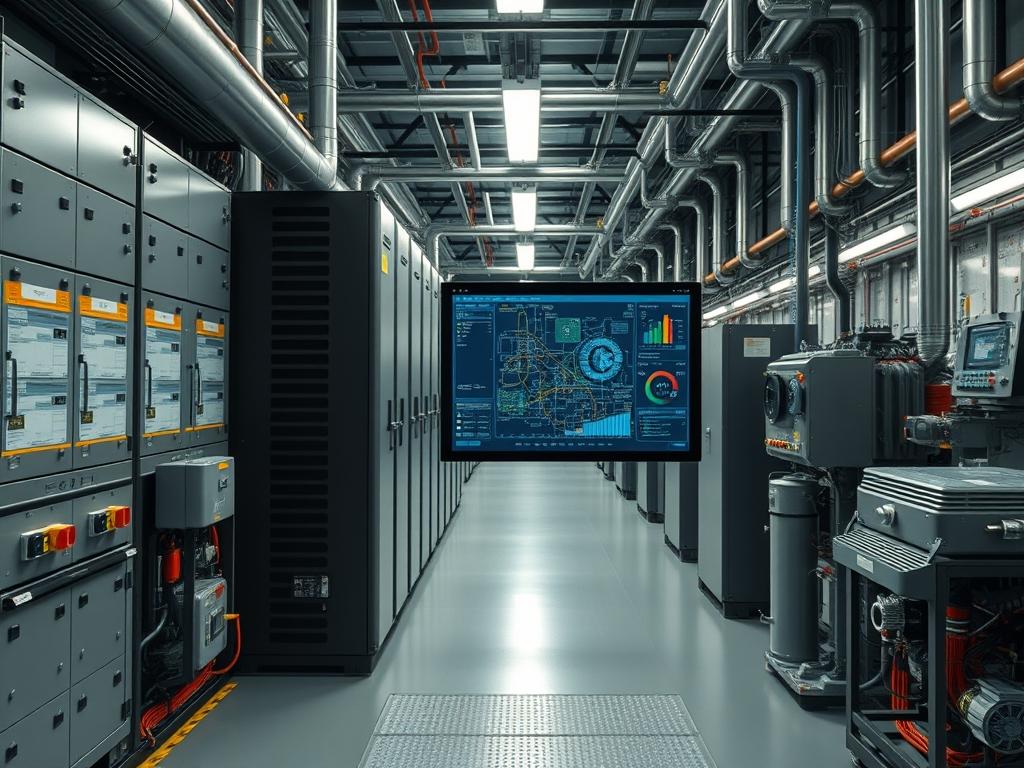
PV Reverse Current Protection in high density photovoltaic architectures utilizes active electronic monitoring to replace sacrificial overcurrent devices. In utility scale arrays: especially those utilizing multi-MPPT string inverters: back-feed current occurs when the open circuit voltage of a faulted string drops below the operating voltage of parallel strings. This creates a potential for thermal runaway and fire within the PV modules. Fuse-less controllers mitigate this risk by integrating Hall effect sensors or shunt resistors at each string input to monitor DC current vectors in real-time. The controller firmware compares the current magnitude and direction against a pre-defined reverse current threshold, typically 1.3 to 2.0 times the module short-circuit current. Upon detection of reverse flow, the controller triggers a high-speed disconnection via solid-state switches or internal relays. This approach reduces maintenance overhead and provides granular data on string-level performance via telemetry protocols.
| Parameter | Value |
|———–|——-|
| DC Input Voltage Range | 200V to 1500V DC |
| Current Sampling Rate | 10 kHz to 50 kHz |
| Trip Response Time | < 500ms (Adjustable) |
| Communication Protocol | Modbus TCP/RTU, SunSpec |
| Reverse Current Threshold | 1.1x to 2.5x Isc |
| Thermal Operating Range | -25C to +60C |
| Accuracy Class | +/- 0.5 percent Full Scale |
| Isolation Voltage | 4kV or higher |
| Hardware Profile | 32-bit DSP or ARM Cortex-M4 |
| Security Exposure | Local Bus / Encapsulated Network |
Environment Prerequisites
Implementation requires an inverter or smart combiner box equipped with per-string current monitoring hardware. The controller firmware must support firmware version 4.2.x or higher to enable advanced logic for reverse current detection. Operators must have administrative access to the Modbus register map and the RS485 or Ethernet interface. All PV modules must be rated for the maximum back-feed current specified in the module datasheet. Physical installation requires shielded twisted pair cabling for communication lines to prevent EMI from interfering with sensitive current sensor readings.
Implementation Logic
The engineering rationale for fuse-less protection centers on the speed and precision of solid-state switching compared to thermal fuses. Fuses rely on thermal inertia, which results in slow trip times at low overcurrent multiples. The controller-based architecture uses a Digital Signal Processor (DSP) to execute a continuous monitoring loop. The logic extracts the DC component from each string input through an Analog-to-Digital Converter (ADC). When the current vector $I_n$ indicates flow from the common DC bus back into the string, the firmware initiates a counter. If the negative magnitude exceeds the I_rev_limit for a duration longer than T_trip, the controller sends a logic-low signal to the Gate Driver of the input MOSFET or triggers a mechanical relay. This encapsulates the failure within a single input channel, preventing the entire array from shutting down while protecting the faulted branch.
Calibrate Current Sensing Hardware
Initialize the current sensors to establish a zero-current offset. This ensures that the ADC counts accurately represent the physical current flow. Use a Fluke 376 FC clamp meter to verify the DC current at the string input and compare it against the controller readout.
“`bash
Example CLI command for sensor offset calibration
set-sensor-offset –channel 1-12 –value 0.02A
get-sensor-readings –all
“`
The controller stores these offsets in non-volatile memory. Any drift in the Hall effect sensors can cause false positives for PV Reverse Current Protection.
System Note: High ambient temperatures can cause magnetic hysteresis in sensors. Always perform calibration at stabilized operating temperatures.
Configure Protection Thresholds
Access the controller configuration interface via Modbus or the local technician console. Define the reverse current limit based on the module short-circuit current derived from the site specific PVSyst report or module nameplate.
“`yaml
protection_settings:
reverse_current_threshold: 15.6A
trip_delay_ms: 200
auto_reconnect_attempts: 0
latch_fault: true
“`
Setting `latch_fault` to true ensures the string remains isolated until a manual inspection is performed. This prevents repetitive arcing if the fault is intermittent.
System Note: The DSP uses a rolling average filter on current samples to ignore high frequency noise generated by the MPPT switching frequency.
Map Telemetry Traps
Configure SNMP or Modbus traps to alert the central SCADA system when a reverse current event occurs. The architecture uses specific error codes to differentiate between standard overcurrent and true reverse current.
“`json
{
“modbus_address”: 40056,
“description”: “String 1 Reverse Current Fault”,
“data_type”: “uint16”,
“unit”: “FaultCode”
}
“`
The monitoring service should watch for register 40056 transitions. A value of `0x0001` indicates a detected fault, while `0x0002` indicates a hard lockout.
System Note: Use Wireshark with a Modbus dissector to verify that packets are being transmitted between the controller and the gateway without dropped frames.
Verify Disconnection Logic
Test the physical disconnection by simulating a voltage drop on a single string using a variable DC power supply if safe testing conditions permit. Alternatively, use the controller software to force a trip and measure the impedance at the string terminals using a Megger insulation tester.
“`bash
Force trip command for testing
controller-cli –force-trip –string-id 4
check-relay-state –id 4
“`
This verifies that the relay or MOSFET driver is responding to the firmware logic signals.
System Note: Ensure the DC bus is discharged before performing continuity tests on isolated strings to prevent equipment damage.
Dependency Fault Lines
Sensor Saturation:
– Root Cause: Magnetic fields from adjacent high-current conductors interfere with the Hall effect sensor.
– Symptoms: Erratic current readings or constant “Reverse Current” alarms despite normal operation.
– Verification: Use a gauss meter to check for stray magnetic fields near the controller input block.
– Remediation: Increase physical spacing between DC conductors or install Mu-metal shielding.
Firmware Desynchronization:
– Root Cause: The MPPT tracking loop and the protection loop share the same CPU cycles with improper priority.
– Symptoms: Delayed trip times exceeding 2 seconds during high-irradiance periods.
– Verification: Inspect the top or htop output if the controller runs a Linux-based OS; check for high interrupt latency.
– Remediation: Update firmware to a version that utilizes hardware-level interrupts for the protection routine.
Thermal Throttling of Switchgear:
– Root Cause: Excessive heat in the combiner box increases the $R_{ds(on)}$ of isolation MOSFETs.
– Symptoms: String power output gradually decreases as the controller limits current to protect the switch.
– Verification: Use an infrared camera to locate hotspots on the controller PCB.
– Remediation: Improve enclosure ventilation or replace thermal interface materials on the heat sink.
Troubleshooting Matrix
| Error Message | Fault Code | Diagnostic Step | Verification Method |
|—————|————|—————–|———————|
| I_REV_FAULT | E-021 | Check string Voc | Multimeter at string terminals |
| SENSOR_BIAS_ERR | E-045 | Reset zero-offset | Controller CLI readout vs clamp meter |
| RELAY_STUCK_OPEN | E-088 | Physical inspection | Continuity test with system powered down |
| COMM_SYNC_LOST | E-009 | Inspect RS485 wiring | Oscilloscope check for signal noise |
| BUS_VOLT_UNBAL | E-112 | Check string matching | Verify all strings have identical module counts |
Execute journalctl -u solar-controller.service to view the timestamped sequence of events leading up to a fault. Look for SIG_REV_CUR entries which indicate the exact moment the threshold was crossed.
Performance Optimization
To maximize throughput, minimize the resistive losses in the sensing circuit. Use high precision shunts with low temperature coefficients. Optimize the MPPT scanning interval so it does not coincide with the protection sampling window: this reduces the noise floor of the current measurement. Implementing a secondary low-pass filter in the digital domain can help differentiate between actual reverse current and transient inductive kicks from neighboring motors or equipment.
Security Hardening
Isolate the controller management network using a VLAN and implement strict firewall rules. Only allow Modbus traffic from the IP address of the authorized SCADA host. Disable unused services such as Telnet or HTTP if they are enabled by default. Use TLS for any communication exiting the local site to protect against man-in-the-middle attacks that could spoof string status.
Scaling Strategy
For larger sites: group several string controllers into a hierarchical architecture. Use a master-slave configuration where a central site controller aggregates fault data. This allows for coordinated response sequences, such as Shedding non-critical strings if a catastrophic reverse current event threatens the main DC bus stability. Redundancy should be implemented at the communication level with dual-ring Ethernet topologies to ensure fault visibility is never lost.
Admin Desk
How do I clear a persistent reverse current alarm?
Verify the string polarity and voltage with a multimeter. If the string is healthy, use the clear-faults command in the controller CLI or reset the specific register via Modbus. Ensure no physical shorts exist before clearing.
Can I adjust the sensitivity of the protection?
Yes, modify the reverse_current_threshold parameter. Increasing it reduces nuisance trips from shading but increases the thermal stress on the modules during a fault. Use the module manufacturer recommended $I_{rc}$ rating as your maximum limit.
Does this protection work at night?
The controller typically enters a low-power sleep state at night. However, if the DC bus remains energized by battery storage, the controller stays active to prevent battery back-feed into the solar strings if a ground fault occurs.
What happens if the communication cable is cut?
The controller is designed to operate autonomously. While remote monitoring will fail, the local logic in the DSP will continue to monitor the sensors and trigger the disconnect hardware if a fault condition is met.
Why use a controller instead of a 20A fuse?
Controllers offer programmable trip curves and real-time telemetry. Unlike fuses, they do not suffer from thermal aging or “nuisance blowing” due to ambient heat. They also allow for remote resets, significantly reducing the Mean Time To Repair.