
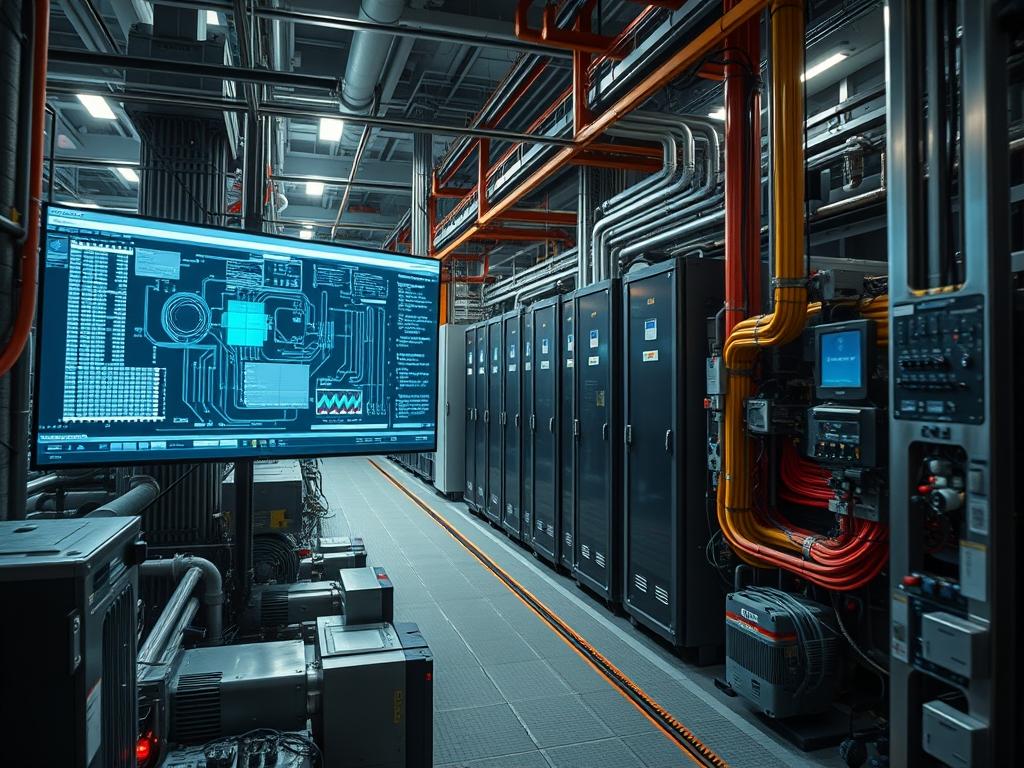
Series Wiring Logic serves as the fundamental architecture for increasing localized electric potential across a single conductive pathway. Within industrial power distribution and sensor network infrastructures, this logic enables the aggregation of individual voltage sources to meet the high input thresholds required by power inverters, DC-to-DC converters, or industrial control units. By arranging components in a head to tail configuration, the system forces a uniform current (I) to flow through every element in the chain, while the total voltage (V) becomes the cumulative sum of the individual potential differences across each component. This approach is critical for high density energy storage systems, such as lithium-ion battery arrays, and telecommunication power plants where 48V or higher operating environments are mandatory. The operational integrity of series wiring depends entirely on the continuity of the circuit: a single point of failure within any component or connection results in an immediate open circuit state, halting all current flow. This dependency necessitates rigorous physical layer auditing and the implementation of bypass diodes or redundant logic in mission critical applications. Properly executed series configurations reduce the required gauge for conductors by maintaining lower amperage for a given power output, thereby optimizing material costs and reducing thermal dissipation requirements within high density cabinets.
| Parameter | Value |
| :— | :— |
| Operating Standard | IEC 60364 / ANSI/IEEE Std 141 |
| Voltage Calculation Policy | V_total = V1 + V2 + … + Vn |
| Current Behavior | Constant (I_total = I1 = I2 = In) |
| Recommended Hardware | DIN Rail Terminals / Busbars / Insulated Ferrules |
| Resistance Aggregation | R_total = R1 + R2 + … + Rn |
| Termination Protocol | Screw-down clamp or spring-cage tension |
| Monitoring Protocols | Modbus TCP / SNMP / MQTT |
| Security Exposure | Physical access / Logic Controller manipulation |
| Environmental Tolerance | -40C to +85C (component dependent) |
| Resource Requirements | Passive conductive paths / Active monitoring nodes |
Configuration Protocol
Environment Prerequisites
Successful implementation of Series Wiring Logic requires strict adherence to physical and logical dependencies. All power sources or sensors must share compatible amperage ratings: mixing components with different current capacities leads to thermal bottlenecks and premature failure of the lowest-rated element. Technicians must ensure compliance with National Electrical Code (NEC) standards regarding conductor insulation ratings, as the cumulative voltage must not exceed the dielectric strength of the wiring or terminal blocks. Software requirements for monitoring include a telemetry gateway running a Linux distribution (e.g., Debian or RHEL) with systemd for service management and access to the modbus-tools suite for register polling. Controller firmware must be updated to the latest stable release to support high-precision analog-to-digital conversion (ADC) for voltage sensing across the entire string.
Implementation Logic
The engineering rationale for Series Wiring Logic centers on the principle of increasing the system potential without increasing the current load. In high-power scenarios, maintaining a low current reduces the $I^2R$ power loss, which is the primary cause of heat generation within infrastructure. The logic follows Kirchhoffs Voltage Law (KVL), stating that the sum of all electromotive forces and voltage drops in a closed loop must equal zero. When integrating this into a logic controller or SCADA system, the software layer must be configured to treat the entire string as a single virtual power entity. The dependency chain is linear: the output of the first cell feeds the input of the second. This creates a high-voltage failure domain where the insulation must be rated for the peak theoretical voltage, even if individual components operate at low potentials. Communication between the sensing layer and the management layer typically utilizes an encapsulated protocol like Modbus, where individual shunt resistors provide localized data that is then aggregated at the edge gateway.
Step By Step Execution
Physical Node Mapping and Polarity Verification
Before applying torque to any terminal, technicians must map the physical nodes to verify the anode-to-cathode sequence. In a series circuit, the positive terminal of the first source must connect to the negative terminal of the subsequent source. Use a Fluke 87V digital multimeter to verify the individual potential of each source before integration.
System Note: If polarity is inverted on a single node, that node will subtract from the total voltage rather than add to it, potentially causing reverse current flow through the component.
Terminal Torque and Conductivity Testing
Secure the interconnects using calibrated torque screwdrivers to ensure contact resistance is minimized. High contact resistance at any junction in the series will result in localized thermal inertia, leading to junction melting or fire. Use a micro-ohmmeter to verify that junction resistance does not exceed 100 micro-ohms.
System Note: High resistance at a single point in the series string limits the throughput of the entire system, as the total resistance (R_total) is additive.
Logic Controller Integration and Register Mapping
Access the logic controller via SSH or a dedicated management console. Configure the PID controller or the analog input module to interpret the total voltage signal. If using a Modbus gateway, map the registers to capture the raw ADC values.
“`bash
Example: Using mbpoll to verify voltage register on a Modbus slave
mbpoll -m tcp -a 1 -r 40001 -c 1 -p 502 192.168.1.50
“`
System Note: The register 40001 represents the scaled voltage value. Ensure the scaling factor in the controller matches the physical voltage divider ratio used for sensing.
Daemonized Monitoring and Alarm Configuration
Finalize the implementation by enabling a daemonized service to monitor the series string health. The service should log to syslog or a dedicated time-series database. Configure alarm thresholds for “Under-Voltage” and “Over-Voltage” based on the sum of the nominal component ratings.
“`bash
Example: Checking service status for the voltage monitor
systemctl status voltage-audit.service
journalctl -u voltage-audit.service -f
“`
System Note: Monitoring should include a “Delta” check to ensure no individual component in the series is deviating significantly from the mean voltage of the group.
Dependency Fault Lines
Series Wiring Logic deployments are susceptible to several critical fault lines that can disrupt infrastructure operations.
1. High Impedance Failure: This occurs when a termination point oxidizes or becomes loose. Because current is constant throughout the series, a high-resistance junction generates heat proportional to the square of the current, leading to a thermal runaway at the contact point. Symptoms include voltage sag at the load and visible charring on terminal blocks.
2. Insulation Breakdown: As voltage accumulates, the potential difference between the conductor and the grounded chassis increases. If the total voltage exceeds the insulation rating of any single wire in the series, an arc-to-ground event will occur. This is verified using a Megger insulation tester.
3. Current Bottlenecking: If a 10A rated battery is placed in series with a 100A rated battery, the entire string is limited to 10A. Attempting to draw more current will cause the 10A component to overheat and fail. This is a common design flaw in heterogeneous systems.
4. Signal Attenuation in Sensor Series: When sensors are wired in series (e.g., current loops), the return signal can be degraded over long distances due to the cumulative resistance of the wire. This results in inaccurate data payloads at the controller.
Troubleshooting Matrix
| Symptom | Fault Code | Verification Command | Remediation |
| :— | :— | :— | :— |
| Zero Voltage Output | E-001 (Open Loop) | netstat -an | grep 502 | Check for physical break in conductor |
| Lower than Target V | E-002 (Polarity) | multimeter – DCV | Identify and flip inverted source |
| Excessive Heat | E-003 (Resistance) | thermal_cam_scan | Re-torque all terminals to spec |
| Fluctuating Signal | E-004 (EMI) | snmptrapd -f -Lo | Inspect shielding and grounding |
| Controller Timeout | E-005 (Logic) | journalctl -xe | Restart monitoring daemonized service |
Successful physical diagnostics require a systematic approach:
1. Isolate the string from the load.
2. Measure total $V_{oc}$ (Open Circuit Voltage).
3. If $V_{oc}$ is zero, perform a continuity test between each node to find the open circuit.
4. If $V_{oc}$ is present but low, measure the voltage drop across each individual component.
Optimization And Hardening
Performance Optimization
To maximize throughput, minimize the cumulative resistance of the series string. Use high-purity copper busbars instead of stranded wire for interconnects. In environments with high vibration, use spring-loaded terminal blocks to maintain constant pressure and prevent the development of high-resistance junctions. Implement a “Balancing Circuit” to ensure that individual nodes in the series maintain equal voltage levels, which prevents any single component from being over-stressed.
Security Hardening
Hardening the series wiring infrastructure involves both physical and logical layers. At the physical layer, use tamper-evident seals on enclosures containing high-voltage series strings. At the logic layer, isolate the monitoring network using a VLAN. Use encrypted protocols like SNMPv3 or Modbus over TLS to prevent an attacker from injecting false voltage data into the SCADA system, which could mask a critical failure or trigger a false emergency shutdown.
Scaling Strategy
Horizontal scaling in series logic involves creating multiple series “strings” and then placing those strings in parallel. This N+M architecture provides both high voltage (from the series component) and high current capacity (from the parallel component). When scaling, ensure that each series string has its own dedicated circuit breaker or fuse. This prevents a failure in one string from overloading the remaining parallel strings.
Admin Desk
How is total voltage calculated in a series loop?
Total voltage is the arithmetic sum of all individual sources. If you have four 12V batteries in series, the output is 48V. You must ensure the load is rated for the final aggregated potential to avoid equipment destruction.
What happens if one component in the series fails?
In a standard series configuration, a single component failure creates an open circuit. This stops all current flow to the load. To mitigate this, engineers often implement bypass diodes that allow current to flow around a failed node.
Why does current remain constant across all series nodes?
According to the principle of charge conservation, there is only one path for electrons to flow. Therefore, the number of electrons passing through any point in the circuit per second must be identical for all components in that path.
Can I mix different voltage sources in series?
Yes, provided their amperage ratings are identical. The total voltage will still be the sum, but the component with the lowest current rating will dictate the maximum safe throughput for the entire string to prevent thermal failure.
What tool is best for diagnosing series faults?
A high-quality digital multimeter with continuity and min/max capture is essential. For industrial systems, use an infrared thermal imager to quickly identify high-resistance junctions that are generating excess heat before they lead to a full system outage.