
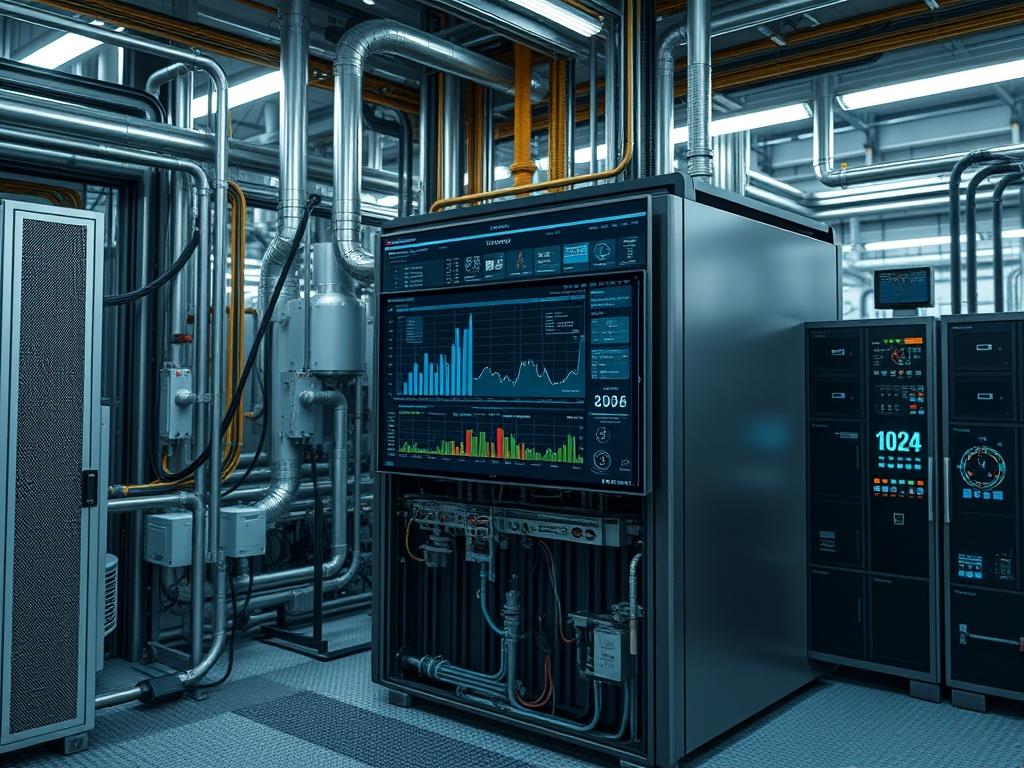
Automating an Equalization Charge Schedule within industrial power systems is a critical maintenance protocol used to reverse the buildup of negative chemical effects in flooded lead-acid battery strings. The primary objective is the deliberate, controlled overcharging of the battery cells to remove lead sulfate crystals and redistribute the electrolyte concentration. In large scale power infrastructure, such as telecommunications hubs or off-grid data centers, electrolyte stratification occurs when acid concentrates at the bottom of the cell, leading to plate degradation and capacity loss. An automated Equalization Charge Schedule mitigates this by generating controlled gas bubbles through electrolysis, which physically agitates the electrolyte to restore a uniform specific gravity.
The integration layer for this automation typically resides between a Programmable Logic Controller (PLC) or a Battery Management System (BMS) and the power conversion hardware, such as an inverter-charger or a localized Rectifier module. This process is operationally dependent on high precision thermal monitoring and electrolyte level telemetry. Failure to maintain these dependencies can lead to thermal runaway, excessive hydrogen gas deployment, or plate warping. The timing of an Equalization Charge Schedule is usually determined by a combination of elapsed cycle time, measured voltage variance between cells, and environmental temperature profiles, ensuring that the overcharge occurs only when the system is within safe thermal inertia limits.
| Parameter | Value |
| :— | :— |
| Equalization Voltage (12V Nominal) | 15.0V to 16.2V DC |
| Maximum Current (C-rate) | 0.05C to 0.10C |
| Temperature Compensation Coefficient | -3mV to -5mV per cell per degree C |
| Standard Duration | 60 to 180 minutes |
| Default Communication Protocol | Modbus TCP/RTU or CANbus |
| Industry Standards Compliance | IEEE 450, IEEE 1188 |
| Operational Humidity Range | 0 to 95 percent non-condensing |
| Security Protocols | TLS 1.2 for remote telemetry, SSH for local CLI |
| Hardware Interface | Dry contact relay or RS485 Serial |
| Recommended Monitoring Resolution | 100ms sampling rate |
Environment Prerequisites
Successful deployment of an automated Equalization Charge Schedule requires specific infrastructure state validation. The controller must run firmware versions supporting custom charge profiles: for example, Victron Venus OS version 2.90 or higher, or Schneider Conext firmware 1.10+. Hardware requirements include a calibrated thermal sensor attached to the center-most battery in the string to capture peak thermal mass. The network must permit Modbus traffic on port 502 or MQTT on port 1883 for real-time telemetry extraction. Furthermore, the battery bank must be a flooded lead-acid type; Sealed Valve Regulated Lead Acid (VRLA) or Gel batteries are generally not compatible with high voltage equalization and will suffer permanent damage if this protocol is applied incorrectly. Specific gravity sensors, while optional, provide the most accurate trigger for the equalization logic.
Implementation Logic
The architecture utilizes a state-machine approach where the automation script acts as a supervisor over the primary charging daemon. The supervisor monitors the cumulative Amp-hours (Ah) discharged and the time elapsed since the last equalization event. When the predefined threshold is reached, the supervisor initiates a pre-check sequence. This sequence verifies that the battery bank is currently in the “Float” stage and that the ambient temperature is below 30 degrees C. Once these conditions are met, the supervisor issues a Modbus write command to the charge controller to elevate the target voltage setpoint.
The logic includes an interrupt-driven safety loop. If the thermal sensor reports a rate of change exceeding 2 degrees C per 10 minutes, the process is immediately aborted, and a “High Temp Alarm” is broadcast via SNMP or MQTT. This encapsulation ensures that the high voltage state is never left orphaned if the primary management service fails. The service is implemented as a daemonized service in the user-space, communicating with the kernel-space serial drivers via a standard abstraction layer.
Configure Modbus Register Mapping
Communication with the charge controller is established by mapping the specific registers responsible for charging modes. For most industrial MPPTs or rectifiers, the equalization mode is toggled via a specific holding register.
“`bash
Example: Use mbpoll to check current charge state on Unit ID 1
mbpoll -a 1 -r 43121 -t 4:int /dev/ttyUSB0
“`
The automation script must verify the register address for “Equalization Target Voltage” and “Equalization Duration.” Modifying these values updates the internal volatile memory of the controller. System Note: Always verify the register offset in the manufacturer documentation, as some use 0-based indexing while others use 1-based indexing.
Establish Thermal Interlock Logic
Thermal runaway is the primary failure mode. The controller must be programmed to poll the temperature sensor every 5 seconds. If using a Python-based supervisor, the logic should look like this:
“`python
import time
from pymodbus.client import ModbusTcpClient
client = ModbusTcpClient(‘192.168.1.50’)
def check_thermal_safety(max_temp):
temp = client.read_input_registers(3302, 1).registers[0] / 10
if temp > max_temp:
# Emergency stop: revert to float voltage
client.write_register(4001, 13.5)
return False
return True
“`
System Note: Use a Fluke multimeter to verify that the temperature reported by the sensor matches the physical casing of the battery before initial activation.
Set Exhaust Ventilation Trigger
High voltage charging produces hydrogen gas. The Equalization Charge Schedule must be synchronized with an auxiliary relay that activates an exhaust fan. This is typically achieved via a dry contact on the controller or a networked relay module.
“`bash
MQTT command to trigger ventilation relay via Tasmota or ESP32
mosquitto_pub -h 192.168.1.10 -t cmnd/vent_fan/POWER -m “ON”
“`
System Note: Ensure the ventilation system has a dedicated power source independent of the battery bank being equalized to prevent a loss of airflow during low-voltage events.
Initialize the Equalization Command
Once all safety interlocks are verified, the command to start the equalization is sent. This moves the charger from “Bulk” or “Float” into the “Equalize” state.
“`bash
Write to the control register to start equalization (e.g., Register 4000)
Value 1 typically initiates the process
client.write_register(4000, 1)
“`
System Note: Monitor the journalctl -u battery-manager.service or the local syslog for confirmation of the state transition. The electrolyte will begin to “boil” or gas, which is the intended behavior for mixing the acid.
Dependency Fault Lines
Electrolyte Level Depletion
- Root Cause: Maintenance intervals were missed, and the plates are exposed to air.
- Observable Symptoms: Rapid temperature spikes and high internal resistance.
- Verification: Visual inspection of the cell levels or low-level float switch activation.
- Remediation: Immediate termination of the equalization cycle and addition of distilled water to the venting cap level.
Modbus Timeout and Packet Loss
- Root Cause: EMI from the high-amperage charging cables interfering with unshielded RS485 wiring.
- Observable Symptoms: Automation script logs “Timeout” or “CRC Error” and fails to update the thermal interlock.
- Verification: Use tcpdump on the management interface to inspect for retransmissions or malformed packets.
- Remediation: Install shielded twisted pair (STP) cabling and ensure the drain wire is grounded at a single point to break ground loops.
Sensor Drift and Calibration Error
- Root Cause: Aging thermistors or low-quality ADC (Analog to Digital Converters) in the controller.
- Observable Symptoms: Constant voltage fluctuations or premature termination of the equalization cycle.
- Verification: Compare the controller temperature reading against a calibrated IR thermometer.
- Remediation: Replace the sensor or apply a software-level calibration offset in the automation configuration file.
Troubleshooting Matrix
| Fault Code/Message | Source | Diagnosis | Action |
| :— | :— | :— | :— |
| `ERR_TEMP_RUNAWAY` | syslog | Temp increased > 1 deg/min | Stop charge, verify airflow |
| `0x03 (Illegal Data)`| Modbus Trap | Out of range voltage setpoint | Check Max V constraint in config |
| `ALM_GASSING_H2` | SensAir Sensor | Hydrogen levels above 2% | Emergency vent, cut DC breakers |
| `State: Incomplete` | Controller Log| Duration timer expired early | Inspect for AC ripple or grid instability |
If the journalctl logs show repeated `Connection refused` messages, check the iptables rules to ensure port 502 is open. Use `netstat -plnt` to verify the Modbus daemon is listening on the correct interface.
Performance Optimization
To maximize throughput of the chemical conversion without excessive heat, implement a “Pulsed Equalization” strategy. Instead of a constant voltage, the PID controller modulates the current in short bursts, facilitating better gas distribution and reducing thermal inertia buildup. This requires high-frequency switching capabilities in the rectifier. Use a PID controller tuned to maintain the electrolyte temperature within a 5 degree C window of the optimal 25 degrees C.
Security Hardening
The equalization protocol can be used as a vector for physical sabotage by forcing a permanent overcharge. Isolate the battery management network using a VLAN. Implement stateful inspection on the firewall to allow only known management IP addresses to send Modbus write commands. Disable all unnecessary services on the controller, such as Telnet or unencrypted HTTP. Use a dedicated hardware watchdog timer to reboot the controller if the automation script hangs while the equalization register is active.
Scaling Strategy
For facilities with multiple battery strings, the Equalization Charge Schedule should be staggered. Do not equalize all strings simultaneously, as the total hydrogen discharge could exceed the ventilation capacity of the room. Implement a queue system in the supervisor script that tracks the “Last Equalized” timestamp for each string and processes them sequentially. This load balancing also reduces the peak AC demand on the charging infrastructure.
Admin Desk
How often should equalization be automated?
Automation should trigger every 30 days or after 10 deep discharge cycles. Frequent equalization leads to grid corrosion and plate shedding. Monitor the specific gravity; if it remains uniform across cells, the schedule can be extended to 60 or 90 days.
Can I equalize batteries during high ambient heat?
No. If the room temperature exceeds 35 degrees C, the thermal delta between the electrolyte and the air is too small for effective cooling. The automation script should gate the process until the ambient temperature drops, typically during nocturnal hours.
What happens if the automation script crashes during equalization?
Safety is maintained via the hardware-level timeout. Most controllers have a “Max Equalize Time” register. Always set this at the hardware level to 120 percent of your software target to provide a fail-safe that terminates the charge independently of the script.
Do I need to change the Float voltage after equalization?
No. After the equalization timer expires, the controller should automatically transition back to the default Float voltage. Ensure your script verifies this transition by checking the “Charge State” register 5 minutes after the scheduled end of the equalization event.
Which log file tracks hydrogen sensor alerts?
On Linux-based gateways, look at /var/log/syslog or use journalctl -t gas_monitor. If using networked sensors, check the SNMP trap receiver logs for OIDs associated with environmental safety. Hydrogen sensors must be calibrated annually to ensure the triggers remain accurate.