
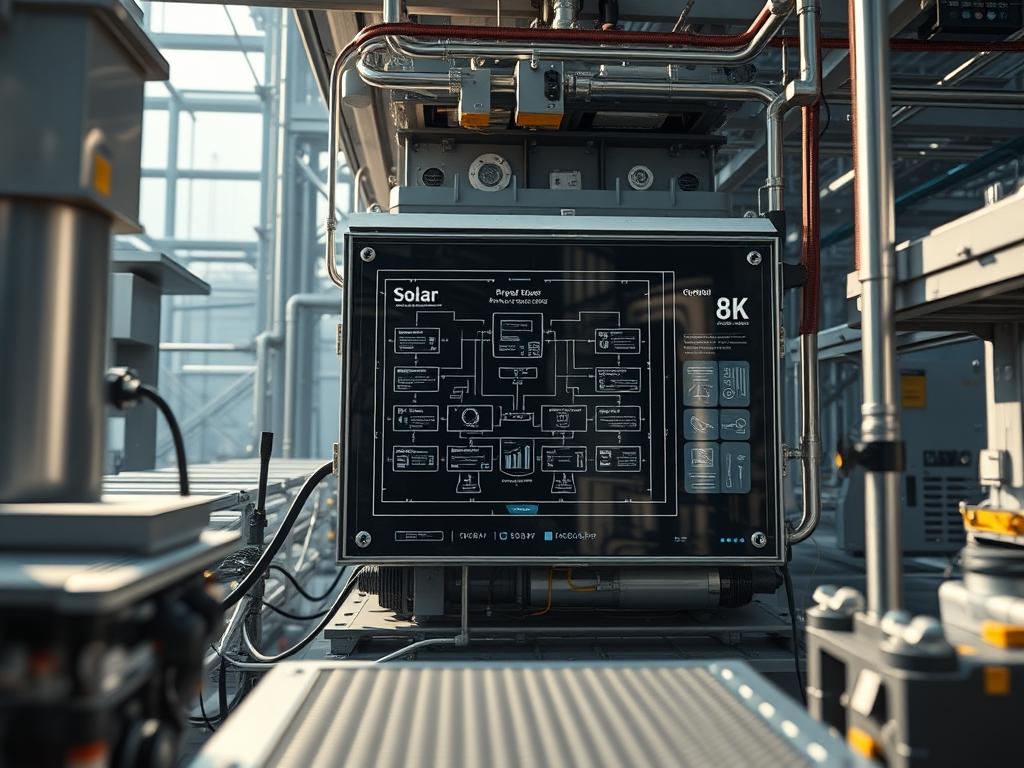
Integrating energy harvesting capabilities into urban glass infrastructure represents a fundamental shift in civil engineering and smart building management. Standard architectural glass remains a passive barrier that contributes to thermal gain and necessitates high cooling loads; however, the deployment of Transparent Solar Panels converts these surface areas into active power generation nodes. This integration is not merely a material upgrade but a complex technical deployment within the broader technical stack of Building Management Systems (BMS). By utilizing wavelength selective photovoltaic systems, infrastructure architects can capture near-infrared (NIR) and ultraviolet (UV) light while maintaining high visible light transmission (VLT). This minimizes the overhead associated with artificial lighting while providing a consistent DC payload to low-voltage building networks, edge computing arrays, or local energy storage systems. The primary problem solved is the wasted energy potential of the vertical building envelope; the solution is an idempotent energy collection layer that functions without compromising the structural or aesthetic integrity of the facility.
TECHNICAL SPECIFICATIONS
| Requirement | Default Port / Operating Range | Protocol / Standard | Impact Level (1-10) | Recommended Resources |
| :— | :— | :—: | :—: | :— |
| Visible Light Transmission | 50% to 85% VLT | ASTM E903 | 9 | Indium Tin Oxide (ITO) |
| Peak Power Output | 20W to 55W per m2 | MODBUS RTU | 8 | MPPT Charge Controller |
| Communication Interface | Port 502 (TCP) / RS-485 | IEEE 1547 | 7 | CAT6 STP / PLC Gateway |
| Operating Temperature | -40C to +85C | IEC 61215 | 10 | Thermal-Insulated Glass |
| Conversion Efficiency | 1% to 10% PCE | N/A | 6 | Organic Photovoltaics (OPV) |
| System Throughput | 48V DC Nominal | IEEE 802.3bt (PoE++) | 8 | 12AWG Stranded Copper |
THE CONFIGURATION PROTOCOL
Environment Prerequisites:
Before commencement, ensure the site meets the National Electrical Code (NEC) Article 690 for solar photovoltaic systems and UL 1703 for flat-plate modules. The administrative gateway must be running a hardened Linux kernel (version 5.15 or higher) or Windows Server with a dedicated Industrial-IoT-Gateway. Hardware dependencies include an RS-485-to-Ethernet-Bridge, high-precision MODBUS-Sensors for irradiance monitoring, and a Digital-Multimeter for circuit verification. Users must have sudo or Administrator privileges to modify network stack configurations and firewall rules.
Section A: Implementation Logic:
The engineering design centers on wavelength selective deposition. Traditional silicon panels are opaque because they absorb the entire visible spectrum to maximize electron excitation. In contrast, Transparent Solar Panels utilize organic molecules or quantum dots tuned to specific non-visible wavelengths. The logic is based on capturing the high-energy UV and high-density NIR photons while allowing the visible light to pass through the substrate via encapsulation. Once the photons are absorbed, the resulting current is channeled through a transparent conductive oxide (TCO) layer, typically Indium-Tin-Oxide, to the busbars located at the frame perimeter. This allows for an aesthetically neutral appearance with functional energy output. The electrical configuration assumes a high-concurrency environment where multiple window nodes feed into a single DC-to-DC optimizer to mitigate the effects of partial shading and signal-attenuation.
Step-By-Step Execution
1. Substrate Verification and Cleaning
Utilize a Spectrometer to verify the transparency indices of the window glass before installation. Clean the inner surface using industrial-grade Isopropyl-Alcohol to remove all particulate matter that could cause signal-attenuation or physical hotspots.
System Note: High surface impedance on the glass substrate increases thermal-inertia and reduces the efficiency of the thin-film adhesive contact; ensuring a clean surface is critical for the long-term integrity of the electrical bond.
2. Physical Busbar Attachment and Encapsulation
Apply the Silver-Conductive-Paste along the vertical edges of the transparent active layer. Secure the Copper-Busbars to the edges using a vacuum-sealed lamination process.
System Note: This action establishes the physical layer of the energy generation stack; improper encapsulation leads to moisture ingress, which triggers galvanic-corrosion and increases the series resistance of the circuit.
3. Integrated Micro-Inverter Integration
Connect the DC leads from the window frame to the local Micro-Inverter or DC-to-DC-Optimizer. Use 12AWG-Shielded-Cables to minimize electromagnetic interference (EMI).
System Note: The optimizer executes a Maximum Power Point Tracking (MPPT) algorithm that acts as a physical kernel for power regulation; it adjusts the impedance to match the varying irradiance levels throughout the day.
4. Logic Controller Network Configuration
Connect the RS-485 output of the inverter to the PLC-Gateway. Issue the command ls /dev/ttyUSB* to identify the communication port. Map the MODBUS registers according to the manufacturer specification to read voltage (V), current (A), and cumulative energy (kWh).
System Note: Mapping these registers allows the Building Management System to treat the window as a networked asset; this data throughput is essential for real-time load balancing and grid-tie synchronization.
5. Deployment of Monitoring Daemon
On the administrative server, create a systemd service to poll the window data. Use sudo nano /etc/systemd/system/solar-monitor.service and define the execution path for the data collection script. Enable the service using systemctl enable solar-monitor and start it with systemctl start solar-monitor.
System Note: This daemon creates a persistent monitoring state; if the process fails, the system will automatically restart it, maintaining idempotent data logging across the infrastructure.
Section B: Dependency Fault-Lines:
Software-level failures often stem from Packet-Loss on the RS-485 bus due to improper termination. Ensure a 120-ohm resistor is placed across the final node in the chain. Mechanical bottlenecks include the thermal expansion of the glass: if the window frame does not account for the thermal-inertia of the glass under direct sunlight, the electrical connections may experience mechanical fatigue. Library conflicts in the monitoring stack, specifically version mismatches in Python’s Pymodbus library, can lead to invalid CRC (Cyclic Redundancy Check) errors in the logs.
THE TROUBLESHOOTING MATRIX
Section C: Logs & Debugging:
When the system reports a “Low-Voltage-Fault” or “Communication-Timeout,” the architect must check the log files located at /var/log/syslog or /var/log/solar-monitor.log.
Error String: “CRC Check Failed”
Action: This indicates high Signal-Attenuation or electrical noise. Inspect the shielding of the RS-485 cable and ensure the ground wire is not shared with high-voltage AC lines.
Error String: “Bus Voltage Out of Range”
Action: Use a Fluke-Multimeter to measure the open-circuit voltage (Voc) at the window terminals. If Voc is normal but the system fails under load, the issue is likely a high contact resistance at the busbar connection.
Physical Fault: Visual Haze or Delamination
Action: Inspect the Encapsulation-Layer. UV degradation can occur if the protective film is not rated for the specific local climate. If delamination is found, the individual unit must be bypassed in the DC string to prevent overall circuit latency.
OPTIMIZATION & HARDENING
Performance Tuning
To improve throughput, implement a PID (Proportional-Integral-Derivative) controller logic within the BMS-Gateway to manage window-integrated blinds or electrochromic tinting. By dynamically adjusting the tint based on real-time PCE (Power Conversion Efficiency) data, the system can balance the energy harvested against the building cooling load. This reduces the thermal-inertia of the interior and optimizes the total energy balance of the facility.
Security Hardening
The physical logic controllers must be isolated from the public internet. Implement Firewall-Rules using iptables or Windows-Firewall to allow incoming traffic only on Port 502 from authorized IP addresses. Disable all unused services on the IoT-Gateway, such as Telnet or unencrypted HTTP. Use Chmod 600 on all configuration files containing MODBUS register maps or API keys to prevent unauthorized read access.
Scaling Logic
Scaling the installation involves transitioning from a single-string topology to a multi-channel array. As more windows are added, the increased concurrency can lead to high heat generation in the central DC bus. Architects should utilize a decentralized inverter architecture where each floor or facade zone operates as an independent power domain. This encapsulation ensures that a single panel failure or communication packet-loss event does not impact the entire building’s energy throughput.
THE ADMIN DESK
How do we handle partial shading on a glass facade?
Use Bypass-Diodes at every window junction. These components ensure that if one section of the transparent array is shaded by a neighboring building, the current flows around the high-resistance area, maintaining total system throughput.
What is the expected lifespan of these transparent layers?
Current organic thin-films are rated for 15 to 20 years. To maintain PCE, the outer glass surface must be kept free of dirt and pollutants using a regular maintenance schedule, as surface debris increases signal-attenuation.
Can I run these panels directly into my existing AC grid?
No: the panels produce high-ripple DC. You must use a Grid-Tie-Inverter that complies with IEEE-1547 standards to synchronize the phase and voltage with the local utility provider before injection.
What happens if the communication link to the window fails?
The MPPT controllers are designed for autonomous operation. While data logging will stop, the physical energy generation remains active; only the monitoring and remote management capabilities are lost until the MODBUS-Service is restored.