
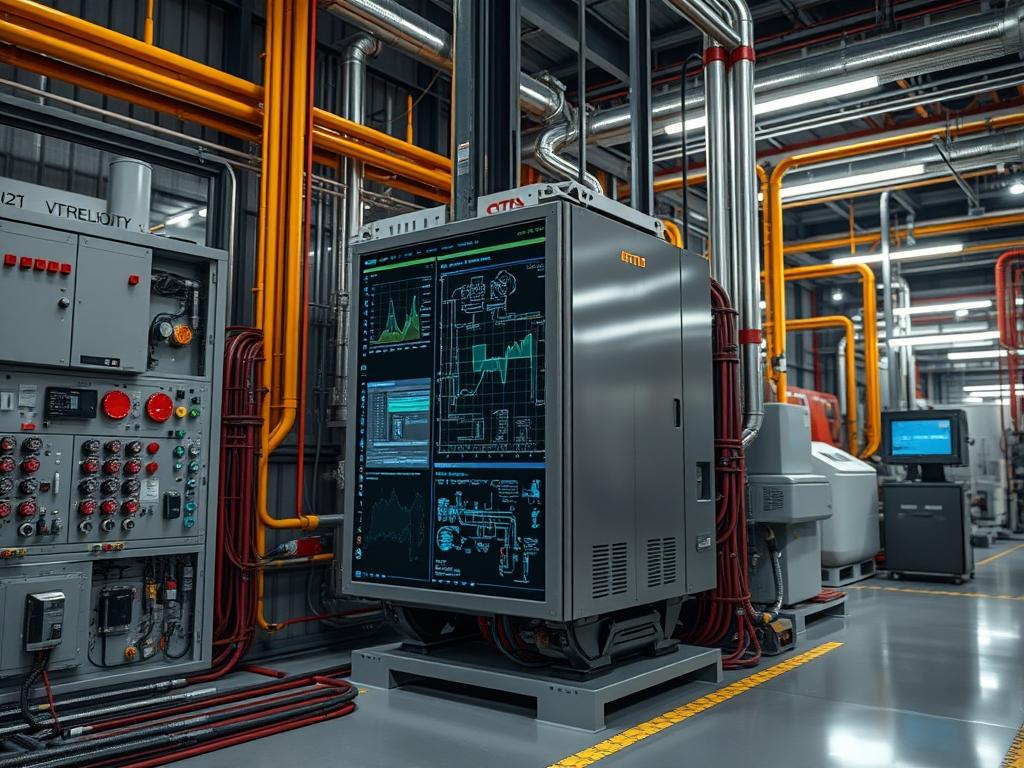
Inverter Installation Clearance defines the critical spatial boundaries required to maintain thermal equilibrium and electromagnetic compatibility within power conversion subsystems. In the context of industrial energy infrastructure, these clearances are not merely physical gaps; they function as passive cooling channels and buffers against inductive coupling. Proper clearance ensures that the Pulse Width Modulation (PWM) switching frequencies and the resulting heat generation from Insulated Gate Bipolar Transistors (IGBTs) do not exceed the thermal design power (TDP) of the enclosure. Failure to maintain these distances leads to rapid degradation of electrolytic capacitors, thermal throttling of the processor logic, and eventual catastrophic failure of the power stage. Operationally, these clearances interface with the facility HVAC systems and dictate the density of the power distribution network. They represent a fundamental layer in the physical-to-digital transition, where hardware state directly impacts the reliability of the supervisory control and data acquisition (SCADA) systems monitoring the grid or industrial load. By adhering to specific spatial requirements, engineers mitigate the risk of fire, reduce the noise floor for communication signals, and extend the mean time between failure (MTBF) for the entire power chain.
| Parameter | Value |
|———–|——-|
| Vertical Clearance (Top) | 300mm to 500mm minimum |
| Vertical Clearance (Bottom) | 200mm to 300mm minimum |
| Horizontal Clearance (Sides) | 100mm to 200mm minimum |
| Front Clearance (Maintenance) | 800mm to 1000mm minimum |
| Operating Temperature Range | -25C to +60C (Derating above 45C) |
| Communication Protocols | Modbus TCP, Modbus RTU, SNMP v3, CANbus |
| Standard Compliance | IEC 62109-1, UL 1741, IEEE 1547 |
| Ingress Protection | IP65 or IP66 for outdoor; IP20 for indoor |
| Thermal Dissipation Method | Forced convection or Natural convection |
| Electromagnetic Compatibility | Class A (Industrial) or Class B (Residential) |
| Typical Humidity Tolerance | 0 percent to 95 percent non-condensing |
—
Configuration Protocol
Environment Prerequisites
Installation requires a structural surface capable of supporting four times the unit weight to account for seismic load and vibration. The installation environment must be free of corrosive gases, conductive dust, and explosive atmospheres unless the unit is specifically rated for such zones. All mounting surfaces must be non-combustible. Required firmware for the integrated system controller should be at the latest long-term support (LTS) version to ensure accurate thermal sensor calibration and fan control logic. Physical infrastructure must include dedicated cable trays for DC, AC, and communication lines to maintain signal integrity.
Implementation Logic
The engineering rationale for clearance revolves around the Rayleigh number and the efficiency of laminar versus turbulent airflow. Heat sinks on the rear or top of the inverter rely on a chimney effect where hot air rises, creating a low-pressure zone that pulls cooler air from the bottom. If the bottom clearance is restricted, the mass flow rate of air decreases, leading to higher junction temperatures at the power semiconductors. Side-by-side installations require increased horizontal clearance to prevent the exhaust of one unit from becoming the intake of the next; a phenomenon known as thermal cascading. From a communication perspective, maintaining distance from high-voltage AC lines is necessary to prevent electromagnetic interference (EMI) on the RS485 or Ethernet bus. The logic follows a strict physical isolation model: the cabinet serves as the first boundary, while the clearance zone serves as the second, protecting the system from external heat sources and ensuring that internal fans can reach their rated volumetric flow (CFM).
—
Step By Step Execution
Physical Perimeter Mapping
Use a laser distance meter to mark the absolute boundaries on the mounting surface. Ensure that no conduit, piping, or structural beams encroach upon the 300mm top and 200mm bottom zones. This space must remain permanently unobstructed.
System Note:
A digital inclinometer or Fluke 180LG laser level ensures the inverter is mounted perfectly vertical. Deviations greater than 5 degrees can disrupt the internal airflow patterns designed by the manufacturer, leading to localized hotspots on the PCB.
Thermal Barrier Verification
Deploy a thermal imaging camera (such as a FLIR E series) to baseline the ambient temperature of the mounting wall while the system is under load. Verify that no adjacent equipment, such as transformers or large motors, are contributing to a localized ambient temperature exceeding 40C.
System Note:
Check the SNMP traps or Modbus register 40072 (typical for temperature) to verify that the internal ambient sensor matches the external measurement.
Communications Path Isolation
Route all Modbus TCP or CANbus cabling through a separate lead-off from the power cables. Maintain a minimum of 50mm separation between data lines and AC power lines when running in parallel. If paths must cross, they should cross at a 90-degree angle to minimize inductive coupling.
System Note:
Use a network cable tester to verify the Signal-to-Noise Ratio (SNR). Excessive EMI caused by inadequate clearance can cause frame errors visible in the ifconfig or netstat -i output on the gateway device.
Fan Intake and Exhaust Calibration
Forced-air cooled units require a vacuum test at the intake. Use an anemometer to measure the air velocity at the bottom intake vents. Compare this against the hardware specification sheet.
System Note:
If the velocity is below the rated threshold, check for filter clogs or physical obstructions in the clearance zone. Use systemctl status inverter-daemon to ensure the cooling service is running and not in a restricted state.
—
Dependency Fault Lines
Clearance-related failures often manifest as intermittent software errors or hardware derating events.
- Thermal Throttling:
* Root Cause: Insufficient top clearance causing heat re-circulation.
* Symptoms: Inverter output power drops despite high input (clipping), logs show “Over-temperature Derating.”
* Verification: Measure the temperature delta between the intake and exhaust; a delta exceeding 20C indicates poor airflow.
* Remediation: Remove obstructions or increase the vertical gap to 500mm.
- Inductive Signal Degradation:
* Root Cause: Communication cables routed through the clearance zone of high-power AC lines.
* Symptoms: Intermittent Modbus timeouts, CRC errors, or sensor drift.
* Verification: Use an oscilloscope to check for 50/60Hz noise on the data lines.
* Remediation: Reroute cables to the outer edge of the clearance boundary using shielded twisted pair (STP).
- Mechanical Resonance:
* Root Cause: Mounting on a hollow or thin-walled surface without a backplate.
* Symptoms: High-frequency audible noise, loosened terminal connections over time.
* Verification: Visible vibration on the enclosure during high-load switching.
* Remediation: Install a 5mm steel backplate or isolation dampers between the inverter and the wall.
—
Troubleshooting Matrix
| Fault Code | Description | Verification Command / Tool | Diagnostic Step |
|————|————-|—————————–|—————–|
| ALM-201 | Internal Overheat | cat /var/log/inverter/thermal.log | Check for blockage in the top 300mm zone. |
| ERR-502 | Comm Bus Failure | netstat -s | grep error | Verify distance between RS485 and AC output. |
| WRN-105 | Fan Stall | journalctl -u fan-control.service | Inspect bottom clearance for dust/debris. |
| ALM-303 | DC Overvoltage | Modbus register 30005 | check for external heat-induced resistance. |
| ERR-009 | Ground Fault | Megohmmeter / Fluke 1587 | Inspect clearance zone for moisture ingress. |
Realistic syslog entry for clearance-related thermal issues:
`May 24 14:10:02 pwr-inv-01 InverterModule[442]: WARNING: Internal Temp 85C exceeds threshold 80C. Initiating 20% power derate.`
`May 24 14:10:05 pwr-inv-01 InverterModule[442]: INFO: Fans ramped to 100% (5200 RPM).`
—
Optimization And Hardening
Performance Optimization
To maximize throughput, the clearance zones should be integrated into the facility’s airflow management. Utilizing a “cold aisle” configuration where the inverter intakes face a cooled air source can improve conversion efficiency by 1 to 2 percent. Reducing the thermal inertia of the mounting surface by using aluminum heatsink spacers between the unit and the wall further improves dissipation.
Security Hardening
Physical clearance acts as a secondary security layer. Maintaining the front clearance of 1000mm ensures that maintenance personnel have a clear egress path and sufficient space to operate without contacting live components. Ensure all communication ports (USB, RJ45) located within the clearance zone are physically capped when not in use to prevent unauthorized local access or environmental contamination.
Scaling Strategy
When scaling horizontally, implement a “Staggered Height” deployment or use a common bus-bar system with centralized cooling. For high-density installations, transition from natural convection to forced air cooling with centralized PLC monitoring of the clearance ambient temperature. This allows for predictive maintenance where fan speeds are adjusted based on the aggregate heat load of the room rather than individual sensor data.
—
Admin Desk
How do I measure clearance if the inverter is already installed?
Use a digital ultrasonic distance sensor or a standard calibrated tape measure. Check four points: top, bottom, left, right. Compare against the manufacturer’s manual. Any measurement below 90 percent of the recommended value requires immediate relocation or forced airflow intervention.
Can I install multiple inverters without horizontal gaps?
Only if the manual explicitly supports “Zero-Gap” installation. Most require 100mm to 200mm. Without this, heat transfers between enclosures, causing the center units in a row to overheat and fail long before the end units.
What is the impact of dust within the clearance zone?
Dust acts as an insulator and restricts airflow. A 1mm layer of dust on a heat sink can increase its thermal resistance significantly. Clearances must be kept clean to ensure the intended convection remains effective over years of operation.
Does vertical clearance change based on altitude?
Yes. At altitudes above 2000 meters, air is less dense and carries less heat. You must increase the vertical clearance by approximately 10 percent for every 1000 meters of additional elevation to compensate for the reduced cooling capacity of the air.
Are there specific clearance requirements for the DC disconnect?
The DC disconnect or circuit breaker usually requires its own 50mm to 100mm clearance from the inverter chassis. This prevents heat transfer from the inverter from causing nuisance tripping of the thermal-magnetic trip elements inside the breaker.