
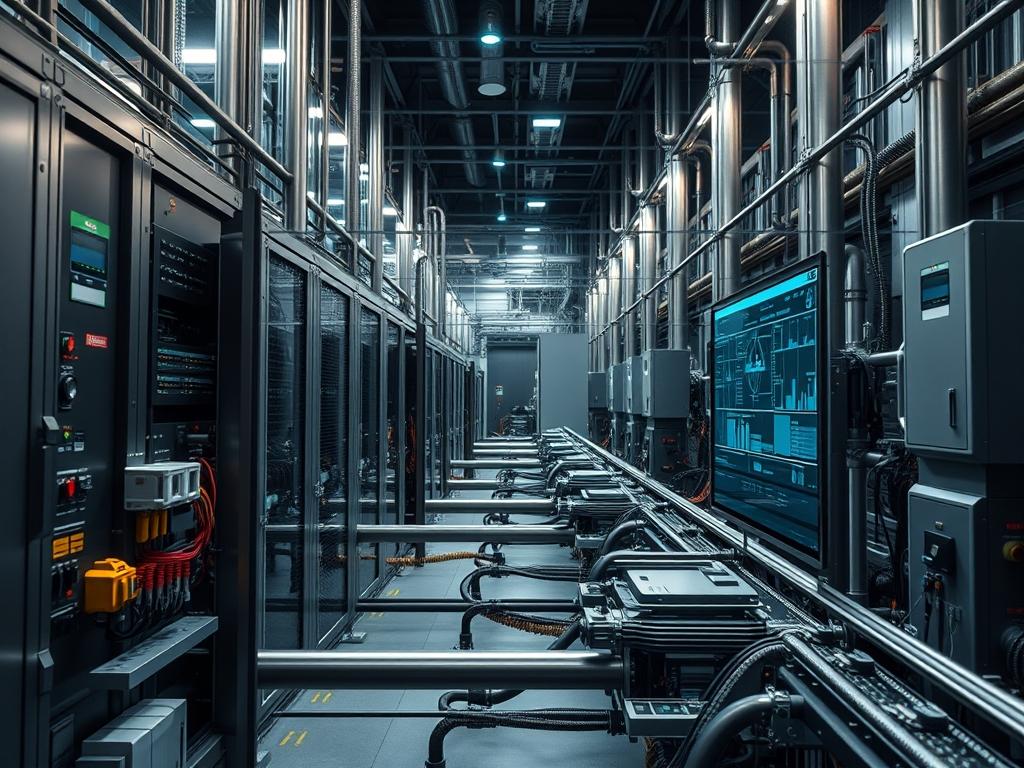
Conduit bending techniques represent a critical physical layer optimization within industrial control systems and data center power distribution. Proper execution of offsets and saddles ensures that raceway systems navigate structural impediments without violating the minimum bend radius requirements specified by NEC Article 358 or exceeding the tension limits of high speed signal media. In environments where electromagnetic interference or radio frequency interference requires rigid metal conduit or electrical metallic tubing, improper bending geometry introduces mechanical stress and localized impedance variations. These physical flaws can lead to cable jacket degradation during longitudinal pulling operations, particularly in high density fiber optic or triple phase power deployments. Failure to adhere to calculated bend constants results in cumulative error across long runs, directly impacting the raceway system’s thermal dissipation capacity and increasing the risk of conductive faults. A precision approach to routing allows for predictable cable tension and facilitates future capacity expansion by maintaining the cross-sectional integrity of the raceway.
| Parameter | Value |
| :— | :— |
| Industry Standards | NEC Article 344 (RMC), Article 358 (EMT) |
| Friction Coefficient | 0.35 to 0.55 (Material Dependent) |
| Operating Temperature | -40C to +120C (Typical Enclosure Boundary) |
| Max Fill Ratio | 40 percent (3 or more conductors) |
| Grounding Continuity | Mandatory via listed fittings/bonds |
| Minimum Bend Radius | 6 to 10 times internal diameter |
| Thermal Expansion Coefficient | 12.0 x 10^-6 m/mK (Steel) |
| Pulling Tension Limit | Function of conductor sidewall pressure |
| Bending Angles | 10, 22.5, 30, 45, 60 degrees |
| Hardware Profile | Mechanical hand bender or hydraulic ram |
Environment Prerequisites
Installation environments must be surveyed for structural obstructions such as HVAC ducting, beam flanges, and existing low voltage tray systems. The engineer requires a mechanical bender calibrated for the specific conduit trade size (e.g., 3/4 inch or 1 inch EMT). All components must comply with UL 797 standards. Personnel must ensure that the floor surface provides high friction to prevent tool slippage during the application of foot pressure. For installations involving high frequency signal cables, the bend radius must be verified against the cable manufacturer’s specification, which often exceeds the minimum radius defined by the electrical code.
Implementation Logic
The engineering rationale for specific bending configurations centers on minimizing the total degrees of bend in a single run, which is restricted to 360 degrees between pull points to limit pulling tension. An offset bend is used to move the conduit path into a different parallel plane, usually to enter an enclosure or avoid a shallow obstacle. This is achieved by creating two equal angles in opposite directions. A saddle bend is a sequence of three or four bends used to bridge a perpendicular obstruction while returning to the original plane. The logic relies on trigonometric constants: the distance between bends is the product of the obstruction height and the cosecant of the bend angle. Precision marking is required to account for “shrinkage,” which is the effective loss in linear length as the conduit travels diagonally.
Determining Offset Geometry and Multipliers
Calculate the distance between marks by identifying the height of the obstruction and selecting a standard angle of constant. For a 30 degree offset, the multiplier is 2.0. If the obstruction is 4 inches high, the distance between bends must be 8 inches.
“`bash
Offset Calculation Example (30 Degree Angle)
Obstruction_Height=4
Multiplier=2
Distance_Between_Marks=$(($Obstruction_Height * $Multiplier))
echo “Distance: $Distance_Between_Marks inches”
“`
The first mark is placed at the starting point of the offset, and the second mark is placed exactly 8 inches downstream. The engineer must account for the “shrink” factor (1/4 inch per inch of rise for 30 degrees) by shifting the initial mark 1 inch forward to ensure the final conduit end aligns with the target junction box.
System Note: Use a high visibility permanent marker on the conduit surface. Ensure the Star or Arrow on the bender head aligns perfectly with the marks. Use a Fluke 62 MAX or similar IR thermometer to monitor conduit temperature in high ambient environments, as elevated temperatures can affect the ductility of heavy wall conduit.
Executing Three-Bend Saddle Transitions
A three-bend saddle is implemented to cross a pipe or structural member using a center bend of 45 degrees and two flanking bends of 22.5 degrees. This configuration is more compact than a four-bend saddle but requires higher precision in alignment. Mark the center of the obstruction on the conduit. Place two marks on either side of the center mark. For a 2 inch obstruction using 45/22.5 degree logic, the flanking marks are placed at 5 inches (2.5 inches per inch of rise) from the center.
“`text
Center_Mark = (Obstruction_Center)
Mark_A = Center_Mark – (Obstruction_Height * 2.5)
Mark_B = Center_Mark + (Obstruction_Height * 2.5)
“`
First, place the bender on the center mark and execute a 45 degree bend. Reverse the bender and execute 22.5 degree bends at Mark A and Mark B. The conduit must remain in a single plane throughout this process to avoid “dog-legs.”
System Note: Maintain continuous foot pressure on the bender pedal. Do not rely on handle pressure alone, as this causes the conduit to kink or deform, reducing the internal cross-sectional area and increasing signal attenuation for high speed data cables.
Aligning the Four-Bend Saddle for Parallel Obstructions
The four-bend saddle consists of two identical offsets facing each other. This is utilized when the obstruction is wide, such as a large HVAC duct. The engineer calculates the first offset to clear the obstruction, allows for a straight run across the top, and executes a second offset to return to the original plane. This maintains maximum throughput for cable pulls by providing a gentler transition than the three-bend variety.
“`text
Offset_1_Mark_1 = Start
Offset_1_Mark_2 = Start + (Height * Multiplier)
Flat_Run = Obstruction_Width
Offset_2_Mark_1 = Offset_1_Mark_2 + Flat_Run
Offset_2_Mark_2 = Offset_2_Mark_1 + (Height * Multiplier)
“`
System Note: Verification of alignment should be performed using a torpedo level with rare earth magnets. Ensure the conduit is level across the flat run of the saddle. Any rotational deviation will cause the conduit to project at an angle, leading to mechanical stress on coupling points.
Dependency Fault Lines
Physical infrastructure failures often stem from improper bend execution which compromises the conduit’s structural integrity or electrical properties.
- Rotational Misalignment (Dog-Legs):
* Root Cause: The conduit was rotated slightly between the first and second bend of an offset.
* Observable Symptoms: The conduit does not lie flat against the mounting surface; couplings appear strained.
* Verification: Use a level on both ends of the offset; they will show different planes.
* Remediation: Minor adjustments can be made with a hickey bar, but significant misalignment requires a re-pull of the section.
- Cross-Sectional Deformation (Kinking):
* Root Cause: Insufficient foot pressure or using a bender sized incorrectly for the conduit diameter.
* Observable Symptoms: Visible flattening of the conduit outer diameter at the apex of the bend.
* Verification: Measure the diameter with calipers; any reduction >5 percent violates standard specs.
* Remediation: Remove the damaged section. Kinked conduit prevents passage of mandrels during cable pulls.
- Calculated Distance Errors (Creep):
* Root Cause: Failure to account for shrink or using the wrong multiplier for the angle.
* Observable Symptoms: The conduit ends do not reach the intended enclosure or overshoot the mounting point.
* Verification: Tape measure comparison against calculated blueprint values.
Troubleshooting Matrix
| Fault Code | Symptom | Diagnostic Step | Verification Tool |
| :— | :— | :— | :— |
| ERR-KINK | Excessive pulling tension | Inspect bend apex for flattening | Calipers / Physical Inspection |
| ERR-ALIGN | Conduit skewed from wall | Check rotational alignment | Torpedo Level |
| ERR-LENGTH | Offset short of target | Re-calculate shrink factor | Tape Measure |
| ERR-GROUND | High resistance at coupling | Check for loose compression nuts | Fluke Multimeter (Ohms) |
| ERR-FILL | Conductors stuck during pull | Verify 40% fill ratio | NEC Table 1, Chapter 9 |
Performance Optimization
To optimize throughput in conduit systems, engineers should prefer 30 degree or shallower offsets whenever structural constraints allow. Steeper angles (45 or 60 degrees) significantly increase the sidewall pressure exerted on cables during the pull, which can lead to jacket failure or permanent attenuation in fiber optics. For high density power runs, ensure that offsets are spaced at least 24 inches apart to allow for heat dissipation. In runs exceeding 100 feet, incorporate a pull box to reset the 360 degree bend count, effectively reducing the cumulative friction coefficient.
Security Hardening and Reliability
Conduit systems must be mechanically continuous and effectively bonded to ground to serve as an equipment grounding conductor. In high security environments, use threaded RMC with liquid-tight fittings to prevent unauthorized physical access to the media. All couplings must be torqued to manufacturer specifications to maintain a low impedance return path for fault currents. For critical infrastructure, apply a secondary support within 3 feet of every bend or offset to prevent vibration-induced fatigue at the coupling points.
Scaling Strategy
When scaling conduit runs in a vertical riser or large horizontal tray, maintain uniform offset angles across all parallel runs to ensure aesthetic and mechanical consistency. This allows for the use of trapeze hangers where multiple conduits are secured by a single threaded rod and strut assembly. Capacity planning should include empty “spare” conduits in every bank to accommodate future network expansion without the need for disruptive core drilling or new structural penetrations.
Admin Desk
What is the standard multiplier for a 45 degree offset?
The multiplier is 1.4. For a 10 inch rise, the marks should be 14 inches apart. Note that 45 degree bends increase shrink significantly compared to 30 degree bends, requiring 3/8 inch adjustment per inch of rise.
How is a dog-leg avoided during a saddle bend?
Keep the conduit stabilized against a straight edge or floor line. Use a torpedo level to ensure the bubble is centered before every subsequent bend. Even a 2 degree rotation between bends will result in a significant alignment failure.
Can I use a 1 inch bender for 3/4 inch conduit?
No. Using an oversized bender prevents the conduit from being properly supported within the shoe. This lack of support inevitably leads to kinking and structural failure of the conduit wall during the bending process.
When should I use a four-bend saddle instead of a three-bend?
Use a four-bend saddle when the obstruction is wider than a few inches, such as a large square duct. Three-bend saddles are designed for small, round obstructions like other pipes or small beams.
What is the maximum number of bends between pull points?
The limit is 360 degrees. This includes all offsets, saddles, and 90 degree bends. Exceeding this limit makes cable pulling extremely difficult and risks damaging the conductor insulation due to excessive sidewall pressure.