
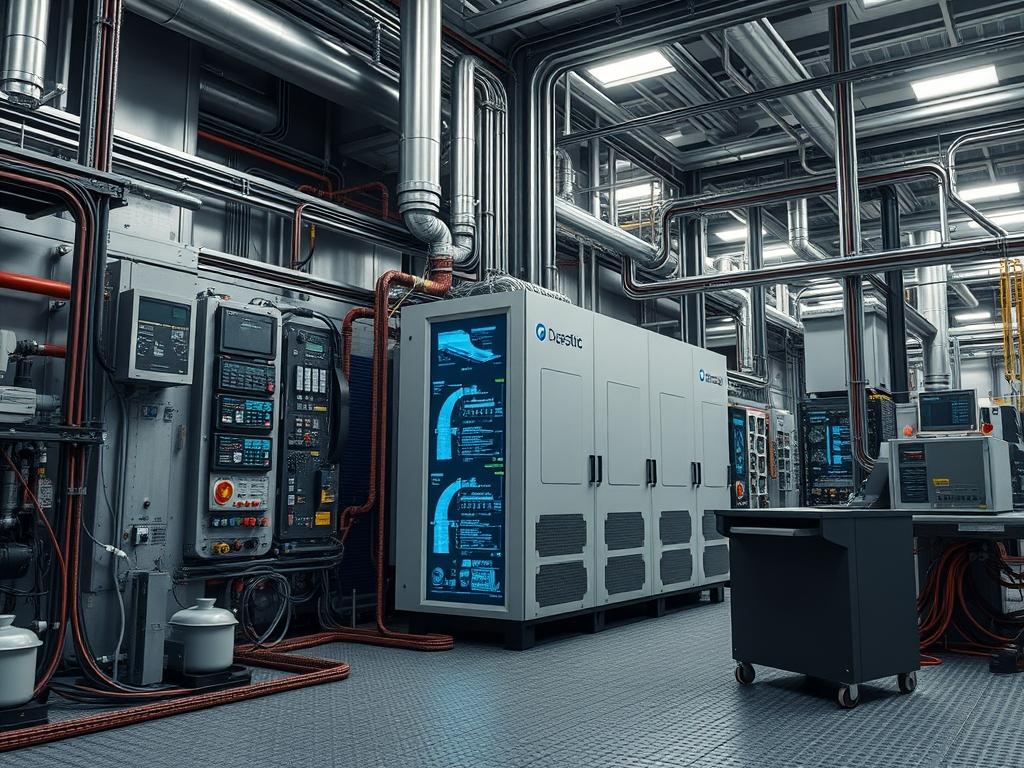
Central Inverter Maintenance ensures the integrity of high capacity power conversion units within utility scale energy installations. These systems serve as the primary gateway between DC generation sources, such as photovoltaic arrays or battery storage, and the AC transmission grid. The conversion process utilizes Insulated Gate Bipolar Transistors (IGBTs) hardware managed by high speed Digital Signal Processors (DSPs) to perform Pulse Width Modulation (PWM) at frequencies typically ranging from 2 kHz to 15 kHz. Reliability in these environments depends on the precise management of thermal inertia and the minimization of Total Harmonic Distortion (THD) to comply with grid interconnection standards. Operational dependencies include liquid or forced air cooling loops, synchronization with grid frequency through Phase Locked Loops (PLLs), and low latency data exchange with site controllers using industrial protocols. Failure in these units leads to immediate throughput loss, potential fire hazards from insulating gas breakdown, or grid instability due to improper reactive power injection. Routine technical inspections address the degradation of film capacitors, semiconductor junction fatigue, and communication bus latency.
| Parameter | Value |
| :— | :— |
| DC Input Voltage Range | 600V DC to 1500V DC |
| AC Output Voltage | 480V AC to 800V AC (Standardized) |
| Communication Protocols | Modbus TCP, DNP3, IEC 60870-5-104, MQTT |
| Ingress Protection | IP54 or NEMA 3R Minimum |
| Operating Temperature | -25C to +60C with derating above 45C |
| Harmonic Distortion (THD) | Less than 3 percent at rated power |
| Efficiency Threshold | 98.5 percent Peak; 98.0 percent CEC |
| Cooling Requirements | 2500 to 5000 CFM forced air or 15 GPM liquid |
| Industry Standards | IEEE 1547, UL 1741 SA/SB, IEC 62109-1 |
| Default Management Port | TCP 502 (Modbus), TCP 20000 (DNP3) |
Configuration Protocol
Environment Prerequisites
Effective Central Inverter Maintenance requires specific software and hardware dependencies to ensure data accuracy and personnel safety. Technicians must utilize a True RMS multimeter rated for CAT IV 1000V and an infrared thermography tool with a minimum resolution of 320×240 pixels. Software requirements include the most recent manufacturer-specific diagnostic suite, a Modbus registers map, and a terminal emulator for serial console access. Firmware versions must be synchronized across all units in a power block to avoid phase unbalance; typically, this involves a base version of 4.2.x or higher for modern 1500V platforms. Permissions must include administrative access to the site SCADA (Supervisory Control and Data Acquisition) system and a local lockout-tagout (LOTO) certification. Physical infrastructure must verify that the medium voltage (MV) transformer is isolated before opening AC compartments.
Implementation Logic
The architecture of a central inverter is designed around the DC bus link, which acts as a buffer between the fluctuating input from an array and the stabilized output required by the grid. Configuration logic prioritizes the DC-to-AC conversion efficiency by adjusting the PWM duty cycle in real time. This process is stateful: the inverter must sense grid voltage and frequency to achieve a “ready” state before closing the AC contactors. Maintenance tasks target the failure domains associated with this state machine. For instance, the transition from “Standby” to “Grid Tie” involves a pre-charge circuit that limits in-rush current to the DC link capacitors. If the pre-charge resistor fails or the timing logic in the DSP desynchronizes, the resulting current spike can delaminate the IGBT busbars. Maintenance workflows focus on verifying these timing constants and ensuring that the electrical encapsulation remains intact against environmental contaminants that cause tracking or arcing.
Step By Step Execution
Thermal Profiling of Power Modules
The first task involves assessing the thermal distribution across the IGBT stacks and DC bus connections while the unit is under load. High resistance at a bolted connection manifests as a localized hot spot.
1. Increase the inverter output to at least 50% of rated capacity.
2. Use a calibrated thermal imager to scan the AC and DC busbar junctions.
3. Compare the Delta-T across all three phases; any variance exceeding 5 degrees Celsius indicates a loose torque or surface oxidation.
4. Inspect the DC link capacitor bank for swelling or localized heating.
System Note: Thermal sensors integrated into the IGBT heat sinks report values to the controller via an analog input. If the Modbus register for “Heatsink Temperature” reads significantly lower than the manual thermal scan, the thermistor or the signal conditioning circuit has failed.
DC Link Capacitor Health Verification
Large film or electrolytic capacitors provide the necessary energy storage for the DC link. These components have a finite lifespan influenced by ripple current and ambient heat.
1. Isolate the inverter and follow LOTO procedures to drain the DC bus voltage to <50V. 2. Use a capacitance meter to measure each capacitor branch. 3. Quantify the Equivalent Series Resistance (ESR) for each bank. 4. Inspect the pressure relief plugs for any signs of electrolyte leakage or physical crowning.
System Note: A degradation in capacitance leads to increased ripple voltage on the DC bus. This ripple can be monitored via the journalctl output of the inverter control daemon, which often logs “DC Bus Ripple High” warnings before a hardware trip occurs.
Firmware and Controller Logic Audit
Software integrity ensures that the protection settings (over-voltage, under-frequency) remain within the Narrow-Trip or Momentary-Cessation limits required by the utility.
1. Connect a laptop to the maintenance port and execute a checksum validation on the existing firmware image.
2. Verify that the Modbus TCP settings match the site network plan, focusing on the IP address, subnet mask, and gateway.
3. Test the Emergency Stop (E-Stop) circuit continuity using a point-to-point wiring check.
4. Review the error log history for “Watchdog Reset” events which indicate DSP instability.
“`bash
Example of checking inverter communication service status
systemctl status inverter-comm-daemon.service
Validating network connectivity to the site controller
ping -c 5 10.10.50.1
Reading the last 50 entries of the fault log
tail -n 50 /var/log/inverter/fault_history.log
“`
System Note: Discrepancies in firmware versions across a multi-inverter site can cause circulating currents between units, especially in master-slave configurations. Always ensure the PID controller parameters are identical across the fleet.
Cooling System and Filter Maintenance
The thermal management system is the most common point of failure. Clogged filters increase internal pressure and reduce the airflow required to dissipate heat from the inductors.
1. Replace all intake and exhaust filters.
2. Inspect the high-flow fans for bearing noise or excessive vibration.
3. Use a digital anemometer to measure the CFM at the exhaust plenum; compare this against the factory baseline.
4. For liquid-cooled units, test the coolant pH and conductivity; high conductivity indicates ion contamination which risks electrical conduction through the coolant.
System Note: Cooling fans are often controlled via an MQTT or Modbus command from the DSP. Verification can be performed by manually forcing the fan speed to 100% through the technician UI to check for mechanical interference.
Dependency Fault Lines
Mechanical and electrical dependencies often introduce hidden failure points in Central Inverter Maintenance.
- Signal Attenuation: In communication loops using RS-485, excessive cable length or improper termination (missing 120-ohm resistors) causes bit errors. This results in intermittent “Inverter Offline” status in the SCADA despite the unit still producing power.
- Thermal Bottlenecks: If the inverter is installed in an enclosure with inadequate ventilation, the ambient temperature may exceed the derating threshold. The unit will then throttle its throughput, which is often misdiagnosed as an IGBT failure.
- Controller Desynchronization: Large scale inverters rely on a precise time sync (PTP or NTP) to timestamp fault events. If the local clock drifts, correlating fault logs with grid disturbances becomes impossible.
- Kernel Module Conflicts: Inverters utilizing embedded Linux for the management plane may experience stalls if custom communication modules conflict with the networking stack during high throughput events.
- Harmonic Interference: High frequency noise from the switching process can couple into low voltage sensor wires if shielding is not properly grounded. This causes “Ghost Faults” such as false ground-leakage detections.
Troubleshooting Matrix
| Symptom | Root Cause | Verification Method | Remediation |
| :— | :— | :— | :— |
| Fault F056 (Ground Fault) | DC array leakage or internal insulation breakdown. | Insulation resistance (Megger) test on DC inputs. | Identify and replace failed module or damaged DC cable. |
| Fault F031 (Grid Overvoltage) | Utility voltage exceeds inverter trip limits. | Measure AC voltage at the terminals with a DMM. | Adjust protection setpoints in coordination with the utility. |
| High IGBT Temp Alarm | Failed cooling fan or blocked heat sink. | Use snmpwalk to check fan RPM registers. | Replace fan or clear debris from the heat sink fins. |
| Communication Timeout | Port collision or IP conflict on the local LAN. | Run netstat -lntp to check for occupied ports. | Reassign unique IP or change Modbus server port. |
| DC Link Undervoltage | Pre-charge relay failure or blown DC fuse. | Check continuity of the pre-charge resistor bank. | Replace the relay or the semiconductor-grade fuse. |
Log Analysis Examples
When diagnosing intermittent outages, examine the system logs for specific patterns.
SNMP Trap Example:
`Trap Type: 1.3.6.1.4.1.InverterModule.0.1; Description: IGBT Over-temperature threshold reached phase B; Value: 95C`
Journalctl Fault Log:
`Feb 12 14:02:11 inverter-01 app[452]: [ERROR] PLL Sync Lost: Phase angle deviation > 5 deg.`
Optimization and Hardening
Performance Optimization
To maximize throughput, the Maximum Power Point Tracking (MPPT) algorithm must be tuned to the specific impedance of the DC array. Adjusting the MPPT step size reduces oscillation around the peak power point during fast-moving cloud cover. Furthermore, reducing the “Wait-to-Reconnect” timer (within utility compliance) minimizes downtime after transient grid events.
Security Hardening
Inverters are increasingly targeted in industrial cyber-attacks. Hardening involves disabling unused services like Telnet or FTP and enforcing SSH keys for management access. Implement a stateful firewall (using iptables) to only allow Modbus traffic from the known IP of the Site Controller.
Scaling Strategy
For sites expanding their capacity, use a modular horizontal scaling approach. This ensures that failures are isolated to a single 2MW to 4MW block. High availability is achieved by implementing an N+1 redundancy for the cooling pumps and using dual-homed network connections to prevent a single switch failure from taking the entire plant offline.
Admin Desk
How can I verify Modbus connectivity without the SCADA software?
Use a command line tool like modpoll. Execute modpoll -m tcp -a 1 -r 40001 -c 10 [Inverter_IP] to read the first 10 registers. If the utility returns values, the physical and network layers are operational.
What is the primary cause of IGBT failure in high humidity?
Condensation leading to tracking on the DC busbars. Maintain the internal space heaters and verify they activate when the unit is in “Standby.” High humidity reduces the dielectric strength of the air, causing localized arcing and carbon tracking.
Why is the inverter derating power on a cool day?
Check the “AC Current Limit” setting in the configuration. The unit may be limited by the thermal capacity of the medium voltage transformer or an artificial limit set by the utility via a DNP3 “Analog Output” command.
How do I identify a failing DC link capacitor early?
Monitor the “DC Ripple Voltage” register via SNMP. A steady increase in ripple magnitude over several months indicates that the capacitor’s internal resistance is increasing or its total capacitance is decreasing, necessitating a scheduled replacement.
Can I update firmware while the inverter is producing power?
No. Firmware updates typically require a reboot of the DSP and the management controller. This triggers an AC contactor opening. Updates must be performed during “Sleep” mode at night or during a scheduled maintenance window.