
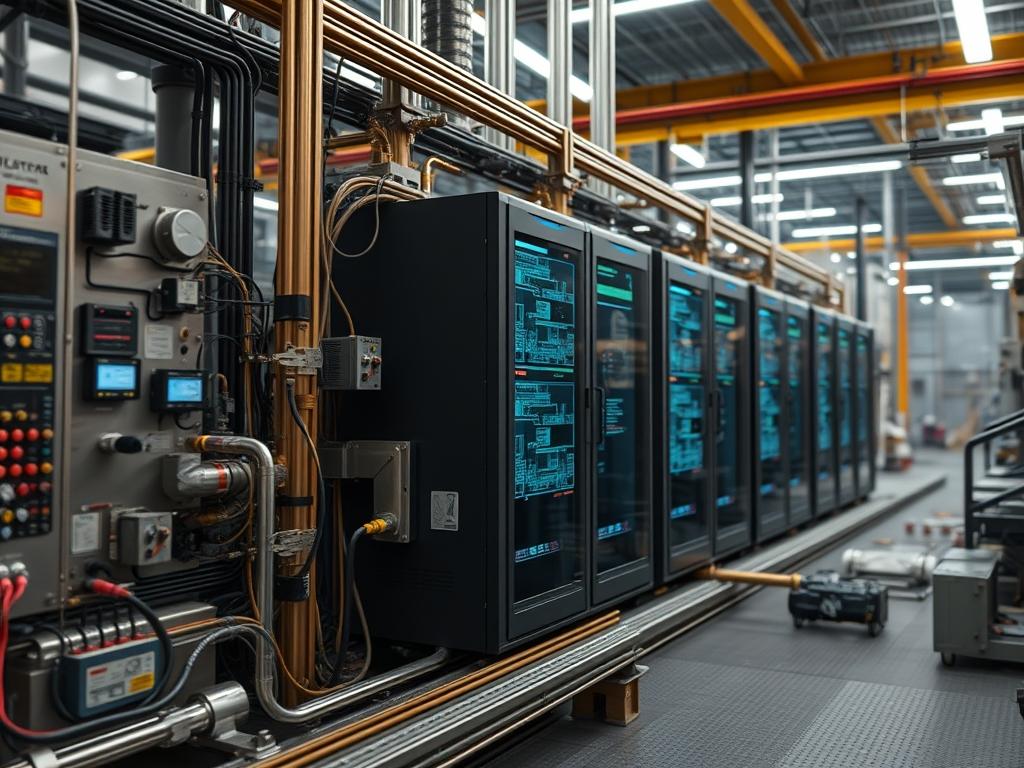
Portrait vs Landscape Orientation selection within industrial monitoring, network operations centers, and embedded signage systems dictates the efficiency of pixel clock synchronization, thermal load distribution, and memory bandwidth utilization. While consumer applications treat orientation as a simple metadata toggle, infrastructure architects must evaluate the hardware-level implications of screen rotation. Native landscape orientation aligns with the physical raster scanning of most LCD controllers, where the row-by-row data refresh matches the horizontal layout of the pixel array. Diverging from this default by implementing portrait orientation introduces a computational requirement for frame buffer transposition, which can increase GPU overhead or introduce latency in the scanout pipeline.
The choice of orientation significantly impacts the physical layout of high density monitoring arrays. Landscape orientation facilitates human peripheral vision for wide-scale observability, but portrait orientation minimizes the footprint required for long-form log analysis and vertical data stream monitoring. System architects must account for the impact on subpixel geometry: subpixel rendering algorithms such as ClearType or FreeType often assume a specific RGB horizontal layout. Rotating the display to portrait reorients this geometry to a vertical stack, which can lead to text fringing or reduced legibility unless the rendering engine is explicitly reconfigured for BGR-V or RGB-V layouts.
—
Technical Specifications
| Parameter | Value |
|———–|——-|
| Native Scanning Direction | Horizontal (Left to Right) |
| Recommended Bit Depth | 8-bit or 10-bit per channel |
| Operating Temperature | 0C to 50C (Standard Industrial) |
| Standard Interface | DisplayPort 1.4a or HDMI 2.1 |
| Control Protocol | DDC/CI via I2C |
| Mount Interface | VESA MIS-D (75mm or 100mm) |
| Resource Requirement | 1x Framebuffer per display |
| Rotation Latency | 0.5ms to 2.2ms (Dependent on SOC/GPU) |
| Subpixel Layout | RGB/BGR (Horizontal) or RGB-V (Vertical) |
| Security Exposure | DDC/CI injection or EDID spoofing |
| Power Consumption | 15W to 120W per panel |
—
Configuration Protocol
Environment Prerequisites
Successful implementation of Portrait vs Landscape Orientation requires a kernel-level display manager capable of Direct Rendering Manager (DRM) or Kernel Mode Setting (KMS). Systems must run Linux Kernel 5.4 or higher for stable hardware rotation support. The display controller must support EDID (Extended Display Identification Data) version 1.4 or higher to communicate physical dimensions and preferred timings. Physical infrastructure must include a stable VESA mounting solution with sufficient clearance for cable bend radii (minimum 50mm) to prevent signal attenuation in high-speed DisplayPort links.
Implementation Logic
The engineering rationale for selecting one orientation over another centers on the data path between the GPU and the display’s Timing Controller (T-Con). In a landscape configuration, the GPU reads the frame buffer in a linear memory address space that maps directly to the physical display rows. This maximizes throughput and minimizes the workload on the memory controller.
When a portrait orientation is commanded, the system must perform a 90 degree or 270 degree rotation. This is accomplished either via hardware rotation in the GPU’s display engine or via a software-based bit-block transfer (BitBLT) operation. Hardware-level rotation is idempotent and does not consume additional CPU cycles, but it requires the GPU to have enough internal bandwidth to handle non-linear memory access patterns. If the hardware lacks native rotation support, the kernel must transpose the entire pixel matrix before each VSync, which can increase thermal output and decrease total available memory bandwidth for other concurrent processes.
—
Step By Step Execution
Kernel Level Display Rotation
Before the graphical user interface initializes, the orientation should be set at the kernel level for console visibility and early boot diagnostics. This is achieved by modifying the bootloader configuration to pass parameters directly to the KMS driver.
“`bash
Edit /etc/default/grub to add orientation parameters
GRUB_CMDLINE_LINUX_DEFAULT=”video=DP-1:panel_orientation=right-up quiet splash”
Update grub configuration
sudo update-grub
“`
The panel_orientation variable accepts normal, upside-down, left-side-up, or right-side-up. This modifies the initial frame buffer mapping at the kernel level, ensuring that systemd logs are readable during the boot sequence.
System Note
Using fbcon=rotate:n is a legacy method for the frame buffer console but may conflict with DRM drivers. Always prefer the video= parameter for modern integrated systems.
X11 Server Reconfiguration
For legacy environments using the X Window System, the xrandr utility provides the primary interface for runtime orientation changes. This utility communicates via the RandR extension to the X server.
“`bash
Identify display output names
xrandr –query
Rotate output DP-1 to portrait (left)
xrandr –output DP-1 –rotate left
Verify current configuration
xrandr –verbose | grep “connected”
“`
The –rotate flag modifies the global transformation matrix within the X server. This action forces the window manager to recalculate all window geometries, which may cause a momentary spike in CPU utilization.
System Note
If the display flickers or resets to a lower resolution, the GPU may lack the necessary pixel clock to drive the requested resolution in a non-native orientation. Check /var/log/Xorg.0.log for rejection messages.
Thermal and Sensor Validation
Portrait orientation alters the natural convection currents within the display housing. Use lm-sensors to monitor the internal temperature of the display controller or adjacent GPU components to ensure the orientation is not trapping heat.
“`bash
Scan for available sensors
sudo sensors-detect
Monitor temperature during burn-in
watch -n 1 sensors
“`
In portrait mode, the T-Con board is often positioned at the top or bottom rather than the center, potentially placing sensitive ICs in a thermal accumulation zone.
—
Dependency Fault Lines
Memory Bandwidth Exhaustion
When scaling to 4K resolutions or higher in portrait orientation, the memory controller must perform non-contiguous reads to assemble a vertical scanline. This can lead to a 20 to 30 percent reduction in effective memory bandwidth. Symptoms include micro-stuttering in high-motion content or “tearing” even when VSync is enabled.
Signal Attenuation and Cable Tension
Portrait orientation often requires a 90 degree rotation of the display cable. Internal wire bundles in DisplayPort or HDMI cables can experience physical stress, leading to intermittent signal loss or bit errors evidenced by “sparkles” on the screen. Verification requires checking the dmesg output for link rate reductions.
Subpixel Rendering Conflicts
Most font rendering engines are optimized for horizontal RGB subpixels. When a display is rotated to portrait, the subpixels become vertically stacked. If the rendering engine is not updated to reflect this (e.g., in fontconfig), text will appear blurry or exhibit color fringing. This is most observable on high-contrast black-on-white text in terminal emulators.
—
Troubleshooting Matrix
| Symptom | Fault Code / Log Message | Verification Command | Remediation |
|———|————————-|———————-|————-|
| Screen Tearing | `[drm] Atomic update failure` | `journalctl -k \| grep drm` | Enable Triple Buffering in Xorg.conf |
| Orientation Reset | `EDID checksum invalid` | `xrandr –verbose` | Replace DP cable; check pin connectivity |
| Thermal Throttling | `GPU Thermal Warning: 95C` | `nvidia-smi` or `sensors` | Increase airflow; reposition display |
| Blurred Text | N/A (Visual Artifact) | `cat /etc/fonts/local.conf` | Update subpixel order to V-RGB |
| No Signal | `OUT_OF_RANGE` | `dmesg \| grep i915` | Reduce refresh rate to 30Hz or 59Hz |
Diagnostic Workflow
1. For display failures, check the kernel log using dmesg | grep -i “display”.
2. Identify if the hardware identifies the orientation via the connector_prop in /sys/class/drm/.
3. Validate the current transformation matrix in X11 using xinput list-props
—
Optimization And Hardening
Performance Optimization
To maximize throughput in portrait orientation, the frame buffer should be allocated in a “tiled” format if supported by the GPU driver. This allows for more efficient cache hits during the rotation transposition. For embedded systems, reducing the color depth from 32-bit to 16-bit can significantly lower the memory bandwidth requirements for vertical refreshing.
Security Hardening
Display orientations are often controlled via the DDC/CI (Display Data Channel Command Interface) protocol. An attacker with local access could theoretically use this protocol to rotate displays or change brightness to cause operational disruption. Hardening involves disabling the i2c-dev kernel module if runtime display adjustment is not required.
“`bash
Blacklist i2c-dev to prevent DDC/CI tampering
echo “blacklist i2c-dev” > /etc/modprobe.d/lockdown-display.conf
“`
Scaling Strategy
For large-scale video wall deployments, a mix of Portrait vs Landscape Orientation is common. This requires a centralized display controller capable of managing multiple asynchronous refresh rates. Use a high-availability load balancer for the data stream and ensure that each display’s EDID is cached locally to prevent boot-time configuration delays if a display fails to handshaking during a power cycle.
—
Admin Desk
How do I fix touch screen misalignment after rotation?
The touch digitizer matrix operates independently of the frame buffer. Use xinput set-prop to apply a Coordinate Transformation Matrix. This maps the touch coordinates to the new visual orientation. A 90 degree rotation matrix is 0 1 0 -1 0 1 0 0 1.
Why does portrait mode cause screen tearing during video playback?
Standard video players use a horizontal scanout. In portrait, the GPU must transpose the video frames. If the flip occurs mid-refresh, tearing results. Enabling TearFree in the Intel or AMD driver configuration usually resolves this by synchronizing the frame flip.
Can I rotate a display 90 degrees using only the BIOS?
Most enterprise BIOS or UEFI environments do not support native rotation. These settings must be handled by the GOP (Graphics Output Protocol) driver or the operating system kernel. Check for a Rotation toggle in the hardware OSD menu first.
Does portrait orientation damage the panel over time?
Most panels are designed for landscape. In portrait, heat from the backlight LEDs rises toward the side electronics rather than out the top vents. Ensure the display has active cooling or sufficient ventilation gaps if running 24/7 in a portrait configuration.
How do I force 1080×1920 if the OS only sees 1920×1080?
Create a custom Modeline using cvt 1080 1920 60. Add this mode to xrandr and apply it to the output. This forces the controller to ignore the default EDID preferred timing and use your specified vertical resolution.