
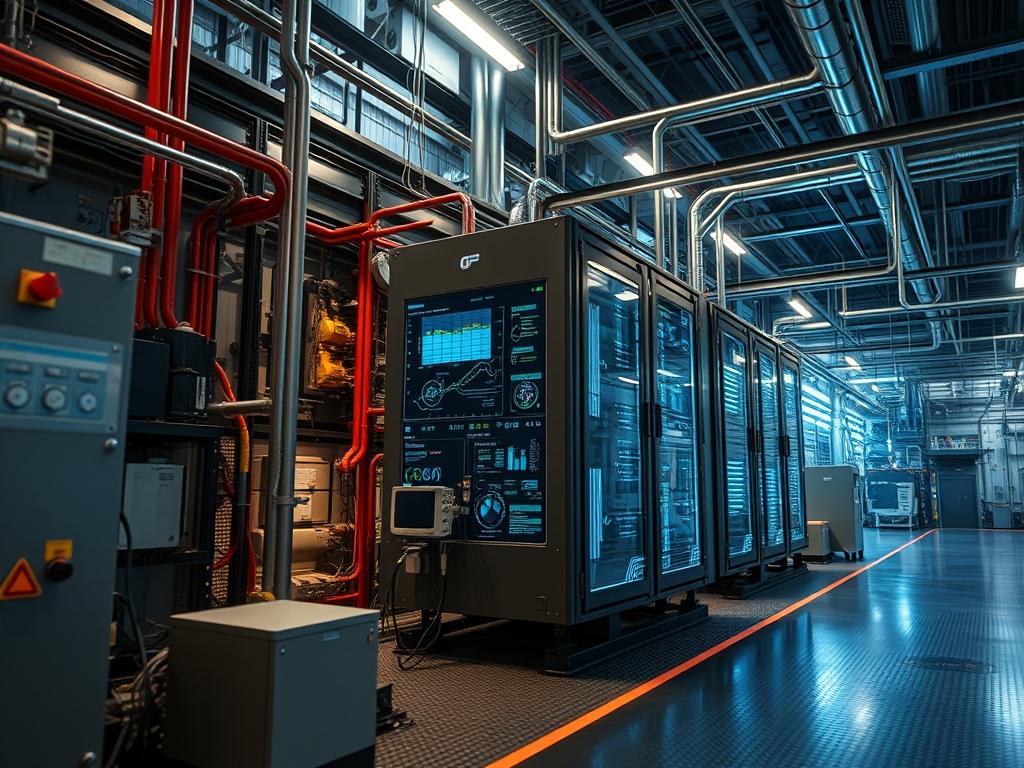
The DC link capacitor bank serves as the primary energy buffer within variable frequency drives, solar inverters, and uninterruptible power supplies. Its function involves smoothing the rectified DC voltage and providing the reactive current necessitated by high speed IGBT or MOSFET switching. Inverter Capacitor Life is dictated by the rate of electrolyte evaporation in aluminum electrolytic variants or dielectric degradation in film capacitors. These components act as a low impedance path for high frequency ripple currents; however, this functionality makes them the most common point of failure in power conversion systems. When ESR (Equivalent Series Resistance) increases due to thermal stress or electrolyte loss, the capacitor generates more internal heat, accelerating a positive feedback loop that leads to structural venting or catastrophic short circuits. Within industrial or utility scale infrastructure, capacitor failure results in immediate system downtime, potential harmonic distortion across the local grid, and internal damage to the power semiconductor modules. Managing Inverter Capacitor Life requires precise control over thermal environments and switching profiles to maintain the chemical and physical integrity of the dielectric layers.
| Parameter | Value |
| :— | :— |
| Nominal Operating Temperature | -40C to +105C |
| Design Life (MTBF) | 50,000 to 100,000 hours at rated ripple |
| DC Bus Voltage Range | 400VDC to 1200VDC (Standard Industrial) |
| Standard Compliance | IEC 61076-2, UL 810, IEEE 519 (Harmonics) |
| Monitoring Protocols | Modbus TCP, SNMP v3, EtherNet/IP |
| ESR Threshold (End of Life) | Greater than 2x initial rated value |
| Capacity Threshold (End of Life) | Less than 80 percent of rated capacitance |
| Resource Requirements | Shielded isolated voltage probes, IR thermography |
| Cooling Requirements | Forced air or liquid cooling (2.0 m/s minimum) |
Environment Prerequisites
Implementation of capacitor health monitoring requires an industrial controller or gateway capable of interfacing with the inverter via Modbus or CANopen. The controller must have a real-time clock for timestamping degradation data. Physical access to the DC bus terminals is necessary for periodic ESR validation using a high frequency LCR meter. Personnel must adhere to NFPA 70E standards, ensuring the DC bus is fully discharged below 50V before manual inspection. Firmware on the inverter control board should be updated to a version that supports high speed sampling of DC link ripple voltage, typically requiring a 10kHz or higher sampling rate to capture switching transients accurately.
Implementation Logic
The architecture for extending Inverter Capacitor Life centers on minimizing the thermal delta between the capacitor core and the ambient environment. The engineering rationale follows the Arrhenius law, where a 10 degree Celsius reduction in operating temperature effectively doubles the component’s lifespan. The system utilizes a closed loop feedback mechanism where the PID controller adjusts the cooling fan speed based on the estimated internal temperature of the capacitor bank rather than the heatsink temperature alone. By correlating DC link ripple voltage with current load, the system predicts the internal I2R losses. Furthermore, the implementation logic includes a de-rating strategy where the PWM carrier frequency is dynamically lowered during periods of high ambient temperature, reducing the number of charge/discharge cycles and the associated ripple current stress on the dielectric.
Thermal Baseline Acquisition
Install a thermal sensor (NTC thermistor or PT100) directly on the capacitor casing, or utilize a Fluke thermal imager to identify hot spots during peak load. The goal is to map the thermal inertia of the capacitor bank against the inverter output power.
“`bash
Example: Querying inverter thermal registers via Modbus
mbpoll -m tcp -a 1 -r 104 -p 502 192.168.1.50
“`
This command retrieves the internal temperature register (104) from the inverter at the specified IP. High readings above 85C indicate a need for immediate cooling intervention or load de-rating.
System Note: Ensure the sensor is electrically isolated from the capacitor terminals to prevent high voltage arcing into the logic circuitry.
Ripple Voltage Analysis
Connect an oscilloscope with isolated probes to the DC+ and DC- bus bars. Measure the peak-to-peak ripple voltage under various load conditions. An increase in ripple voltage over time, while the load remains constant, serves as a primary indicator of capacitance loss.
System Note: Data should be logged to a daemonized service like Telegraf or Prometheus to track long term trends in voltage stability. Sudden spikes in ripple typically precede a capacitor vent event.
Configuring Automated Cooling Logic
Modify the inverter control logic to trigger cooling fans before the capacitor reaches its critical temperature. This reduces thermal cycling stress.
“`c
// Pseudo-code for intelligent cooling fan control
if (cap_temp > threshold_low) {
pwm_fan_speed = calculate_pid(cap_temp, setpoint);
apply_fan_output(pwm_fan_speed);
} else if (dc_ripple > ripple_limit) {
pwm_fan_speed = max_speed; // Emergency cooling for high ESR
}
“`
This logic prioritizes the capacitor health by reacting to both absolute temperature and the electrical symptoms of degradation (ripple).
System Note: Use a relay module for fan control if the inverter’s internal fan headers lack the current capacity for upgraded high-static-pressure fans.
Harmonic Mitigation and Switching Frequency Tuning
Access the inverter parameter set via the CLI or control panel to adjust the carrier frequency. Lowering the frequency from 16kHz to 8kHz significantly reduces the heat generated by the capacitor’s internal resistance but may increase audible motor noise.
“`bash
Example: Adjusting parameter via inverter CLI tool
set_param –id 2001 –value 8000 # Set switching freq to 8kHz
“`
Reducing this value decreases the switching losses and the ripple current passed through the DC link.
System Note: This adjustment affects the harmonic profile of the output; verify that the motor or load remains within its own operational limits after the change.
Dependency Fault Lines
High Equivalent Series Resistance (ESR): As the electrolyte dries, the ESR increases. This is the root cause of localized heating. Observable symptoms include localized casing discoloration and bulging. Verification requires an LCR meter at 120Hz and 10kHz. Remediation involves replacing the capacitor or the entire bank if the age of components is uniform.
Harmonic Injection from Grid: Excess total harmonic distortion (THD) on the AC input can bypass the rectifier and induce a circulating current in the DC link. This causes the capacitors to overheat even at low load. Verification is performed using a power quality analyzer. Remediation involves installing an AC line reactor or a passive harmonic filter at the inverter input.
Controller Desynchronization: If the DC bus voltage sensing circuit becomes uncalibrated, the inverter may overcharge the capacitors. Root causes include resistor divider aging or firmware bugs. Symptoms include repetitive F002 (Overvoltage) alarms. Verification involves measuring the bus with a calibrated Fluke multimeter and comparing it to the SNMP or Modbus readout.
Thermal Bottlenecks: Dust accumulation on the capacitor bank intake grilles prevents effective heat exchange. This leads to a rapid rise in internal temperature during peak throughput. Remediation requires a scheduled maintenance routine for filter replacement and heatsink cleaning.
Troubleshooting Matrix
| Symptom | Fault Code | Verification Method | Root Cause |
| :— | :— | :— | :— |
| DC Link Overvoltage | F0002 / ALM_OV | Measure DC bus vs. Register | Sensing circuit drift or regen energy |
| High Ripple Alert | F026 / RIPPLE_HI | Oscilloscope Vpp measurement | Capacitor aging or phase loss |
| Over-temperature | F015 / TEMP_CRIT | IR Thermography / NTC check | Fan failure or high ambient air |
| Ground Fault | F008 / GRND_FLT | Insulation resistance (Megger) | Leaking electrolyte causing shorts |
Log Analysis Example:
“`text
journalctl -u power_monitor.service
Oct 23 14:05:12 srv-inverter-01 snmptrapd[842]: TRAP: DC_RIPPLE_VOLTAGE (8.2V) exceeds limit (5.0V)
Oct 23 14:05:15 srv-inverter-01 snmptrapd[842]: TRAP: CAP_TEMP (92C) approaching critical threshold
“`
These logs indicate that the capacitor ESR has likely increased, causing higher ripple and subsequent heat generation.
Optimization And Hardening
Throughput Tuning: To maximize Inverter Capacitor Life, implement a soft-start routine for the DC bus. Charging the capacitors slowly through a pre-charge resistor avoids high inrush currents that can damage the internal foil connections. Ensure the pre-charge sequence is monitored by the controller to prevent the resistor from staying in the circuit, which would cause a fire hazard.
Security Hardening: Secure the inverter control interface by disabling unused protocols like Telnet and implementing SNMP v3 with AES encryption. Ensure the physical cabinet is locked to prevent unauthorized adjustment of voltage setpoints or cooling parameters. Isolate the power management network from the general corporate LAN using a VLAN to prevent coordinated attacks on cooling systems.
Scaling Strategy: In high availability environments, utilize an N+1 redundancy for the inverter units. This allows the system to share the total load across more capacitor banks, reducing the ripple current per unit and significantly extending the life of each individual component. Use load balancing logic to rotate the lead inverter, ensuring even wear across the fleet.
Admin Desk
How do I detect a failing capacitor before it explodes?
Monitor the DC bus ripple voltage via Modbus or an oscilloscope. A steady increase in ripple voltage at a constant load over several months is a conclusive indicator of declining Inverter Capacitor Life and increasing ESR.
What is the “reforming” process for stored capacitors?
Electrolytic capacitors stored for over a year require reforming. Gradually apply DC voltage in increments (25, 50, 75, 100 percent) over several hours to rebuild the aluminum oxide layer. This prevents immediate short circuiting upon full power deployment.
Can I replace one capacitor in a bank of four?
It is not recommended. Capacitors in a bank should have matched ESR and capacitance values. A new capacitor will have lower impedance, causing it to take a disproportionate share of the ripple current, leading to premature failure of the new unit.
Does altitude affect capacitor life?
Yes. At higher altitudes, air is less dense, reducing the effectiveness of convective cooling. You must de-rate the current capacity of the inverter by approximately 1 percent for every 100 meters above 1000 meters to maintain nominal internal temperatures.
How does humidity impact the DC link?
High humidity combined with dust levels can lead to tracking and arcing across capacitor terminals. Inverter Capacitor Life is best preserved in a controlled environment using NEMA 4 or IP66 enclosures with integrated heat exchangers to prevent moisture ingress.